After having several terrifically cooperative owls like Isra, which we were able to track for more than three weeks, we've had a run of bad luck on the telemetry front. Fang and Feist, which we radio-tagged last week, both departed over the weekend while Drew, Kim and Hannah were enjoying a couple of days off.
So Monday night they tagged the only owl the King's Gap banding crew caught, a hatching-year female. They bandied around a couple of delicious food-themed names but thought better of it. "We were going to name it Meatballs, but we decided saying that name all night might make us hungry." Drew told me when he called from the woods around 9 p.m. with the news. "We figured it wouldn't be as big a problem with an owl named Tofu," so that's what they went with.
Instead, Tofu posed other problems. After tracking her for several hours near the banding station, the telemetry team followed her as she moved south over the ridge to Cold Spring Hollow, checking on her position every 10 minutes. And then around 3 a.m., between position checks, she simply disappeared. The crew fanned out for the rest of the night, checking from high points throughout Michaux State Forest, but Tofu had left the buffet.
Last night they tried for another telemetry owl at King's Gap, but came up dry - while we had owls at the other two sites, there were none caught at KG. We'll try again tonight.
We're up to 358 saw-whets and five screech owls for the season, still getting two or three a night at each station. In the past week we've had a number of foreign birds come into our nets ("foreign" meaning banded at another site), while several of our owls have shown up elsewhere.
Among the owls we've caught were birds banded at Tadoussac, Quebec in 2007; several from Glenn Proudfoot's operation at the Mohonk Preserve in southeastern New York; and three from Virginia - an owl banded in 2004 in the highlands of western Virginia, one banded in February 2008 in Shenandoah River State Park, and one banded in November 2007 at Kiptopeke on the southern tip of the Delmarva Peninsula. We've caught several other owls for which there was no data in the Banding Lab database.
Our owls have shown up in the past week in South Hadley, Massachusetts; Elk Neck State Park in northern Maryland; and several at Lamb's Knoll in the Catoctin Mountains of western Maryland.
We've also - finally - reached the end of the line with our geolocator project. Last night, Guy Ubaghs deployed the last two at Small Valley - 178 of the tiny tracking devices, which are continuously recording data that will allow us to determine the owls' daily latitude and longitude once we start recovering some of them next year.
None of this would have been possible without an extraordinary effort on the part of our banding crew, especially the banders from Small Valley, who double-teamed most nights this fall so one person could band and the other deploy up to 10 geolocators per night.
A few geolocator-tagged owls have shown up in our nets, and Sunday night I got a call from Dave Darney, who bands saw-whets on the Allegheny Front in Somerset County. He'd just caught a geo-tagged owl we released Nov. 6 at our Small Valley site, about 110 miles to the east. After checking the owl (it and its harness were both in fine shape), he released it - we're hoping to get up to two full migration cycles from the geolocators, so there was no point in taking it off after just nine nights and a relatively short distance traveled.
Showing posts with label King's Gap. Show all posts
Showing posts with label King's Gap. Show all posts
Wednesday, November 18, 2009

Friday, November 13, 2009
Busy week
We're supposed to be on the downward slide to the end of the owl season, but it doesn't feel like it.
Normally, our peak flights come right around Halloween, but a full moon Nov. 2, and a lot of unseasonably mild air, seems to have delayed the migration. The couple of big nights we had on Oct. 18 and 25 tend to mask the trend, but if you look at our capture totals in seven-night blocks, here's what you find:
Oct. 1-7: 0 saw-whets
Oct. 8-14: 9
Oct. 15-21: 74
Oct. 22-28: 60
Oct. 29-Nov. 4: 63
Nov. 5-11: 98
Last night, the 12th, we had another 21 owls between the three sites, and reports from the north make me suspect there are more to come. Holiday Beach in Ontario, across the river from Detroit, is still getting 20-30 owls a night, and Prince Edward Point, on the northeast shore of Lake Ontario, banded 500+ owls this season, of which only two have been recaptured - we normally get a lot of PEPtBO's birds, suggesting they're still to our north.
We've had a bunch of interesting foreign recaptures this week as well. Two have come from Glenn Proudfoot's operation at the Mohonk Preserve in southeastern New York, one from Quebec in 2007, and another from Virginia in 2008. We also caught another old saw-whet, banded as a hatching-year (juvenile) in 2004 by Clair Mellinger in Bergton, VA - which was quite a coincidence, because in 2005 we caught another of Clair's owls, banded that same night the year before.
So far we've caught 22 foreign owls, while eight of our birds have been reported from other sites. Both totals are a little on the low side, especially the latter.
The telemetry crew has been busy all week. Esmeralda had been hanging out south of King's Gap on private land, so they focused their attention on Isra, who has been a real challenge to track, covering a much larger area than past owls have done this year or last. Here's an example of one partial night's tracking, from dusk at 18:00 hours until about 2 a.m.; the polygons are color-coded from pale to dark to make it easier to follow her movements over time.

That night, she covered an area about twice the size of a typical half-night track for one of our 2008 owls. Whether this is just an expression of her personality, her hunting skill (or lack thereof) or a general scarcity of prey, we can't yet say.
On Tuesday night, I joined the tracking crew to follow Isra around Buck Ridge and upper King's Gap Hollow. That night she was behaving herself a little more, making it easier for Hannah and Drew to track her, although Kim had to keep shifting to get a clear bearing.
That same night, the KG banding crew put another radio on a new owl, an adult female nicknamed Fang (hey, just because we think they're cute doesn't mean they aren't ferocious little predators). Two nights later, they tagged an HY female dubbed Feist, because it pulled so much blood from Drew during harnessing.
The timing was perfect, since both Esmeralda and Isra left the same night. Isra in particular had been a real trouper, sticking around since Oct. 19 and giving us a lot of data.
We're almost done deploying our geolocators - out of 178, we have about 15 left. None of the geolocator-tagged owls have turned up at other sites, but then, only one of the 326 owls we've banded so far this year have been recaptured by another site - the remarkable "Wrong Way" Corrigan of an owl I wrote about last weekend.
Normally, our peak flights come right around Halloween, but a full moon Nov. 2, and a lot of unseasonably mild air, seems to have delayed the migration. The couple of big nights we had on Oct. 18 and 25 tend to mask the trend, but if you look at our capture totals in seven-night blocks, here's what you find:
Oct. 1-7: 0 saw-whets
Oct. 8-14: 9
Oct. 15-21: 74
Oct. 22-28: 60
Oct. 29-Nov. 4: 63
Nov. 5-11: 98
Last night, the 12th, we had another 21 owls between the three sites, and reports from the north make me suspect there are more to come. Holiday Beach in Ontario, across the river from Detroit, is still getting 20-30 owls a night, and Prince Edward Point, on the northeast shore of Lake Ontario, banded 500+ owls this season, of which only two have been recaptured - we normally get a lot of PEPtBO's birds, suggesting they're still to our north.
We've had a bunch of interesting foreign recaptures this week as well. Two have come from Glenn Proudfoot's operation at the Mohonk Preserve in southeastern New York, one from Quebec in 2007, and another from Virginia in 2008. We also caught another old saw-whet, banded as a hatching-year (juvenile) in 2004 by Clair Mellinger in Bergton, VA - which was quite a coincidence, because in 2005 we caught another of Clair's owls, banded that same night the year before.
So far we've caught 22 foreign owls, while eight of our birds have been reported from other sites. Both totals are a little on the low side, especially the latter.
The telemetry crew has been busy all week. Esmeralda had been hanging out south of King's Gap on private land, so they focused their attention on Isra, who has been a real challenge to track, covering a much larger area than past owls have done this year or last. Here's an example of one partial night's tracking, from dusk at 18:00 hours until about 2 a.m.; the polygons are color-coded from pale to dark to make it easier to follow her movements over time.

The results of one night of tracking Isra, the wandering saw-whet. (©NSCNA)
That night, she covered an area about twice the size of a typical half-night track for one of our 2008 owls. Whether this is just an expression of her personality, her hunting skill (or lack thereof) or a general scarcity of prey, we can't yet say.
On Tuesday night, I joined the tracking crew to follow Isra around Buck Ridge and upper King's Gap Hollow. That night she was behaving herself a little more, making it easier for Hannah and Drew to track her, although Kim had to keep shifting to get a clear bearing.
That same night, the KG banding crew put another radio on a new owl, an adult female nicknamed Fang (hey, just because we think they're cute doesn't mean they aren't ferocious little predators). Two nights later, they tagged an HY female dubbed Feist, because it pulled so much blood from Drew during harnessing.
The timing was perfect, since both Esmeralda and Isra left the same night. Isra in particular had been a real trouper, sticking around since Oct. 19 and giving us a lot of data.
We're almost done deploying our geolocators - out of 178, we have about 15 left. None of the geolocator-tagged owls have turned up at other sites, but then, only one of the 326 owls we've banded so far this year have been recaptured by another site - the remarkable "Wrong Way" Corrigan of an owl I wrote about last weekend.
Thursday, November 5, 2009
Owl Nightlife, or... what does a saw-whet do at night?
We have now been tracking Isra for over 2 weeks now, with a lot of good data coming from our long nights at King's Gap and in the Michaux State Forest. With the migration season in full swing for the owls, we are now starting to hear the strange barks and whines of the saw-whets as we are walking through the forest. Sometimes it's the owl we are tracking, but often it is another saw-whet in the woods.

Isra has a routine going for her that she repeats every night we have been tracking her. Soon after dark, she leaves her roost and becomes very active, flying back and forth along the King's Gap/Michaux State Forest border. She keeps us on our toes as we run around, trying to figure out where she is off to. Several times she has completely ditched us, only to show up back at near the banding station at King's Gap.
After flying around for several hours, presumably hunting, she often settles down for several hours and gives us some time to relax and enjoy the night sounds other than our feet crunching the newly fallen leaves.
Isra often stays relatively still until shortly before dawn, when she starts flying again and soon ends up in the pitch pine where she will roost for the day. As the sun comes up, we get to go search for the roost site so we know where to find her the following evening.
Mornings are great at King's Gap because there are steady streams of migrating birds flying around. Currently, American Robins steal the show but grackles and juncos are also common in large flocks.
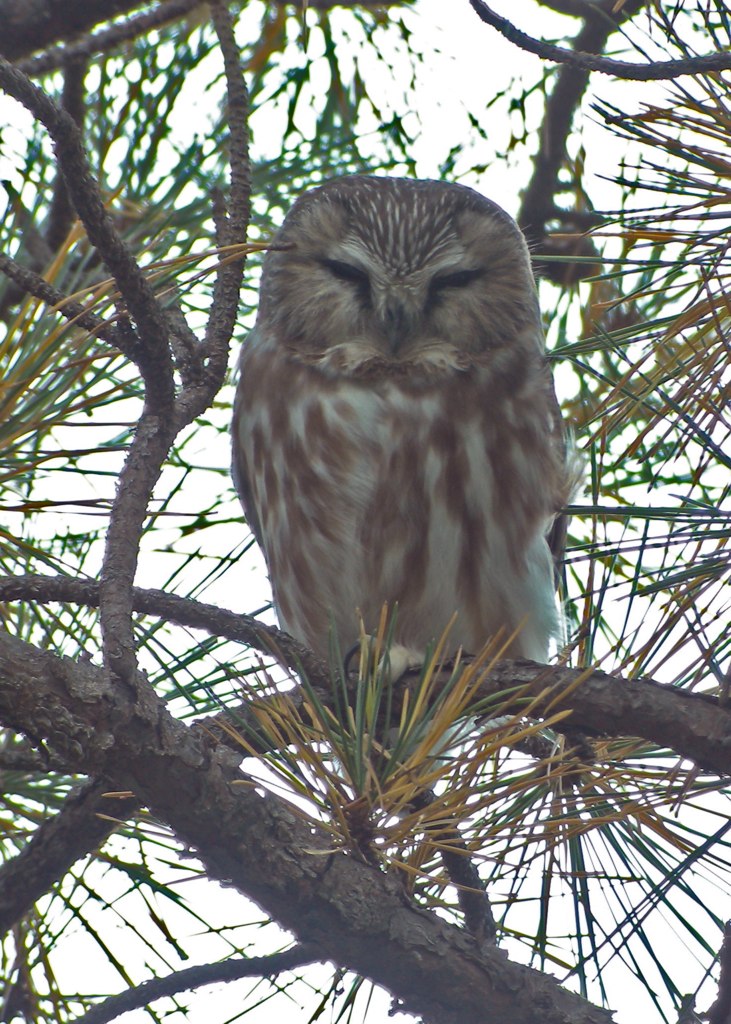
Isra perched high in a pitch pine
Isra has a routine going for her that she repeats every night we have been tracking her. Soon after dark, she leaves her roost and becomes very active, flying back and forth along the King's Gap/Michaux State Forest border. She keeps us on our toes as we run around, trying to figure out where she is off to. Several times she has completely ditched us, only to show up back at near the banding station at King's Gap.
After flying around for several hours, presumably hunting, she often settles down for several hours and gives us some time to relax and enjoy the night sounds other than our feet crunching the newly fallen leaves.
Isra often stays relatively still until shortly before dawn, when she starts flying again and soon ends up in the pitch pine where she will roost for the day. As the sun comes up, we get to go search for the roost site so we know where to find her the following evening.
Mornings are great at King's Gap because there are steady streams of migrating birds flying around. Currently, American Robins steal the show but grackles and juncos are also common in large flocks.
Friday, October 30, 2009
Esmeralda and her food
I don't have too much time before I need to get some sleep but I wanted to post this picture of our newest owl with a transmitter, Esmeralda. She saved our night of tracking last night because we were able to track her from our cars when the weather turned sour and it started misting heavily and then raining. The other saw-whet we are following, Isra, hangs out in the area south of the King's Gap banding station and is quite impossible to track from a car.

Friday, October 16, 2009
Geolocators
Although a big nor'easter storm has temporarily shut us down, we had an exciting couple of nights before the rain and snow hit. Drew, Kim and Hannah have been tracking Xena and Skreech as they hunt the woods near King's Gap. On the banding side, while the number of owls remains quite low for this time of year - just 10 saw-whets and two eastern screech-owls - we've begun deploying the light-sensitive geolocators we're using this season to study their migration.

The geolocators are miniature, backpack-mounted data-loggers, continuously monitoring light levels for up to two years, from which we can determine the rough latitude and longitude of the migrating owl. The tiny units are custom built by the British Antarctic Survey, and have been used to study the migrations of wood thrushes and purple martins, but never saw-whet owls.
This week we began fitting saw-whets with geolocators at our Hidden Valley station, and will soon be doing so at all three of our sites. The harness is made from thin, tough Teflon ribbon that figure-eights around the bird's body, holding the geolocator high in the middle of the back. A short stalk sticks up above the feathers, with the light sensor at the tip. The entire unit and stalk are encased in a light, thin shell of epoxy to protect the innards from sharp owl beaks.

(A special thanks to Marge Gibson and her staff at the Raptor Education Group in Wisconsin, who tested the geolocators and the harnesses on three of their captive saw-whets, even going so far as to create nest boxes with natural flicker- and pileated woodpecker-sized entrance holes, to make sure the sensor stalks didn't interfere with the owls' ability to enter and exit the cavities.)
We were also grateful to York University grad students Maggie McPherson and Callie Stanley for giving up their (Canadian) Thanksgiving holiday to come south to help with the work, and to give us the benefit of their geolocator experience working with thrushes and martins under Dr. Bridget Stuchbury.

From left: Callie Stanley, bander Nate McKelvie (front), Maggie McPherson, Pat Trego (rear), Nada Farah, Baha' Ishaq (rear), Ika Rani Suciharjo and Maria del Mar Contaldi. (©Scott Weidensaul)
Finally, we were delighted this week to welcome a number of the international interns from Hawk Mountain Sanctuary, which is not far from Hidden Valley. Marie del Mar Contaldi from Argentina is working on a master's on vulture and condor biology; Nada Farah from Lebanon serves as the country's Important Bird Areas coordinator; Baha' Ishaq from Palestine is an undergrad at Bethlehem University and the only licensed ringer (bander) in the Palestinian territories; and Ika Rani Suciharjo from Indonesia is a high school biology teacher with extensive experience in environmental conservation. As you can see from the picture, they were thrilled with their first encounters with saw-whets.

A light-sensitive geolocator, which weighs about 2.5g (©Scott Weidensaul)
The geolocators are miniature, backpack-mounted data-loggers, continuously monitoring light levels for up to two years, from which we can determine the rough latitude and longitude of the migrating owl. The tiny units are custom built by the British Antarctic Survey, and have been used to study the migrations of wood thrushes and purple martins, but never saw-whet owls.
This week we began fitting saw-whets with geolocators at our Hidden Valley station, and will soon be doing so at all three of our sites. The harness is made from thin, tough Teflon ribbon that figure-eights around the bird's body, holding the geolocator high in the middle of the back. A short stalk sticks up above the feathers, with the light sensor at the tip. The entire unit and stalk are encased in a light, thin shell of epoxy to protect the innards from sharp owl beaks.

A saw-whet, fitted with a geolocator and ready to go. The sensor stalk protrudes an inch or so above the feathers on the back, continuously recording daylight and darkness. (©Scott Weidensaul)
(A special thanks to Marge Gibson and her staff at the Raptor Education Group in Wisconsin, who tested the geolocators and the harnesses on three of their captive saw-whets, even going so far as to create nest boxes with natural flicker- and pileated woodpecker-sized entrance holes, to make sure the sensor stalks didn't interfere with the owls' ability to enter and exit the cavities.)
We were also grateful to York University grad students Maggie McPherson and Callie Stanley for giving up their (Canadian) Thanksgiving holiday to come south to help with the work, and to give us the benefit of their geolocator experience working with thrushes and martins under Dr. Bridget Stuchbury.

From left: Callie Stanley, bander Nate McKelvie (front), Maggie McPherson, Pat Trego (rear), Nada Farah, Baha' Ishaq (rear), Ika Rani Suciharjo and Maria del Mar Contaldi. (©Scott Weidensaul)
Finally, we were delighted this week to welcome a number of the international interns from Hawk Mountain Sanctuary, which is not far from Hidden Valley. Marie del Mar Contaldi from Argentina is working on a master's on vulture and condor biology; Nada Farah from Lebanon serves as the country's Important Bird Areas coordinator; Baha' Ishaq from Palestine is an undergrad at Bethlehem University and the only licensed ringer (bander) in the Palestinian territories; and Ika Rani Suciharjo from Indonesia is a high school biology teacher with extensive experience in environmental conservation. As you can see from the picture, they were thrilled with their first encounters with saw-whets.
Tuesday, October 13, 2009
Xena, visitors, and better things to come
Well, things are started to click along down here, slowly but surely - and it appears the flood gates have finally opened to our north, promising better owling to come.
Although we only caught two saw-whets Monday night - one at Small Valley and one at King's Gap - the latter bird, an immature female, left with a radio transmitter and a nickname that intern Hannah Panci came up with - Xena, for the TV warrior princess, in recognition of this little fighter's spirit. From her release until about 3 a.m., Xena stayed on the ridgetop near the banding station, then moved down the west side of the mountain, staying put until the tracking crew left her at 7:30 a.m.
Although we didn't have any owls at Hidden Valley, we did have a couple of interesting guests, who will be with us all week. Maggie McPherson and Calandra (Callie) Stanley are grad students at York University in Toronto, studying with Dr. Bridget Stuchbury, a specialist in songbird migration, and one of the first scientists to use geolocators like the ones we'll be deploying this fall.
Maggie and Callie are both working with wood thrushes and purple martins at Bridget's study site in northwestern Pennsylvania, and Callie is also tagging thrushes on their wintering grounds in Costa Rica. They've given up their fall break to drive down from Toronto and spend the week helping us with our geolocator work - and spend some time with owls, since Maggie began banding NSWOs in ninth grade in Ontario, working the Timiskaming stations run by Bruce Murphy.
Speaking of whom, Bruce posted a happy warning to those of us to the south that the wait may soon be over. Friday night they had 95 saw-whets, one of their biggest nights ever, although high winds have cut their catch rate since then. They're up to 390 for the season, and he thinks we in the south will have the roughly average flight I've been expecting this year, which for our sites would mean around 450-500 owls.
Although we only caught two saw-whets Monday night - one at Small Valley and one at King's Gap - the latter bird, an immature female, left with a radio transmitter and a nickname that intern Hannah Panci came up with - Xena, for the TV warrior princess, in recognition of this little fighter's spirit. From her release until about 3 a.m., Xena stayed on the ridgetop near the banding station, then moved down the west side of the mountain, staying put until the tracking crew left her at 7:30 a.m.
Although we didn't have any owls at Hidden Valley, we did have a couple of interesting guests, who will be with us all week. Maggie McPherson and Calandra (Callie) Stanley are grad students at York University in Toronto, studying with Dr. Bridget Stuchbury, a specialist in songbird migration, and one of the first scientists to use geolocators like the ones we'll be deploying this fall.
Maggie and Callie are both working with wood thrushes and purple martins at Bridget's study site in northwestern Pennsylvania, and Callie is also tagging thrushes on their wintering grounds in Costa Rica. They've given up their fall break to drive down from Toronto and spend the week helping us with our geolocator work - and spend some time with owls, since Maggie began banding NSWOs in ninth grade in Ontario, working the Timiskaming stations run by Bruce Murphy.
Speaking of whom, Bruce posted a happy warning to those of us to the south that the wait may soon be over. Friday night they had 95 saw-whets, one of their biggest nights ever, although high winds have cut their catch rate since then. They're up to 390 for the season, and he thinks we in the south will have the roughly average flight I've been expecting this year, which for our sites would mean around 450-500 owls.
Saturday, October 10, 2009
Slow going
The banding stations have been open for a week, but in that time we've netted just a single saw-whet, caught Oct. 5 at our Hidden Valley site - one of the slowest starts we've had in the 13 years we've been studying owl migration.
Part of the reason may lay with the relatively mild, windy, showery weather we've had here in the mid-Atlantic, but I suspect even more of the problem lies to our north - a series of storms that have paraded across southeastern Canada, slowing down the migration.
However, there's a dramatic change in the weather coming over the next few days, with an Arctic air mass plunging down through the Great Lakes and East, with predictions of snow downwind of the lakes and on the higher elevations of New England. We're expecting this cold snap to generate the first good push of owls in our region, perhaps as early as tonight.
Meantime, our radio-telemetry crew has been focusing its attention on the screech-owl we tagged last month, and they're taking a weekend off after six nights of triangulation. Skreech, as they nicknamed the bird, has been hunting the western side of King's Gap State Park and adjacent portions of Michaux State Forest, moving around frequently enough to keep Drew, Hannah and Kim on their toes. Once we start getting saw-whets, they'll switch their attention to them, but we'll continue to keep track of Skreech in the weeks ahead, too.
Part of the reason may lay with the relatively mild, windy, showery weather we've had here in the mid-Atlantic, but I suspect even more of the problem lies to our north - a series of storms that have paraded across southeastern Canada, slowing down the migration.
However, there's a dramatic change in the weather coming over the next few days, with an Arctic air mass plunging down through the Great Lakes and East, with predictions of snow downwind of the lakes and on the higher elevations of New England. We're expecting this cold snap to generate the first good push of owls in our region, perhaps as early as tonight.
Meantime, our radio-telemetry crew has been focusing its attention on the screech-owl we tagged last month, and they're taking a weekend off after six nights of triangulation. Skreech, as they nicknamed the bird, has been hunting the western side of King's Gap State Park and adjacent portions of Michaux State Forest, moving around frequently enough to keep Drew, Hannah and Kim on their toes. Once we start getting saw-whets, they'll switch their attention to them, but we'll continue to keep track of Skreech in the weeks ahead, too.
Monday, October 5, 2009
Skreech and the full moon

"Skreech," the first of this year's owls to be radio-tagged. (©Hannah Panci)
Poets, lovers and songwriters like full moons. Owl researchers, not so much.
For whatever reason, the number of owls caught drops dramatically during a full-moon period, which may explain (along with the lovely, mild weather) why we're 0 for 4 with saw-whets - having opened our 2009 banding operation four nights ago, we still have yet to net our first saw-whet owl.
This isn't unusual - it's often pretty slow the first week of the season, and the migration doesn't peak until about Halloween. In each case, though, the crews at our three sites had plenty to divert to their attention, even in the absence of owls. At Hidden Valley Saturday night there was a fireworks display in the valley, while at Small Valley (where the caretaker has been seeing three large black bears) the volunteers were just glad nothing went bump in the night.
At King's Gap, we actually did catch an owl last week - not a saw-whet, but I'll let Hannah Panci, one of our research interns, pick up the story:
"Meet our red-morph eastern screech-owl (a hatch-year bird, sex unknown), given a gangster name of “Skreech.” After many tries over the course of three nights, Scott, Drew, Kim and I managed to lure it into the net last Wednesday night. Fitted with the newest model of radio transmitter backpack, it was released, and our little research team tracked it until 3 am. We found it again yesterday, sneakily roosting in the open about 30 feet off the ground. We’ll be tracking Skreech throughout the fall, both as telemetry practice and to see how its movements may affect any tagged saw-whets we are following. So look for more updates!"
That's Hannah's photo of Skreech, which we aged as a hatching-year bird - meaning it was born earlier this year, and is entering its first winter - by looking at its feather molt, and the pattern of pale scalloped markings on its primary wing coverts, among other clues. Unlike the migratory saw-whets, we're expecting Skreech to stay fairly close to its banding site on top of South Mountain, although as a young bird, it may still be drifting about, trying to establish a permanent territory. Once it does, though, the bird should sink down roots and stay put for the rest of its life.
Monday, April 13, 2009
Lexi has left the building

Lexi's moved on. (©Karl Kleiner)
Well, all good things must come to an end - and almost four months to the day since we first radio-tagged her, Lexi has left the King's Gap area, presumably heading north to breed.
Since the end of February, she'd been roosting in a small grove of white pines along Yellow Breeches Creek in southern Cumberland County, and every day or two, telemetry coordinator Aura Stauffer's been checking on her. On April 8, Aura was joined by Karl Kleiner, one of our banders who is a professor at York College of Pennsylvania, and two of Karl's students, Katie Kolos and Shawn Fauth, who tracked down Lexi with Karl and Aura's help.

Katie Kolos (left) gets a bearing on Lexi while Aura Stauffer and Shawn Fauth watch. (©Karl Kleiner)
The next day, Aura was back, realizing that with the opening of trout season, Lexi suddenly had lots of company in her streamside retreat. Aura pointed out the owl to a couple of young boys and their father who were fishing the Yellow Breeches. "One of the boys ran over to his mom, who was fishing, and told her he just saw the smallest owl in Pennsylvania," Aura reported. "How cute!"
On Saturday, telemetry volunteers Carl and Pat Leinbach, who helped so much last fall and winter with our nighttime work, checked on Lexi and found her signal right where we expected. But by Easter morning, when Karl Kleiner and Susan Klugman checked, there was only silence, and the Leinbachs found the same later in the day. Aura was out this morning, and she confirmed what we all suspected -- Lexi was finally on her way north.
"After tracking her for four months, I will miss the little bugger," Aura said. "She has given us a lot of interesting information; not to mention a whole freezer full of owl pellets (my Mom would be appalled)."
It's been a remarkable experience to track one bird for so long, and Lexi gave us amazing insights into saw-whet winter ecology and behavior. And who knows? She may end up in our nets (or someone else's) down the road. In the meantime, we all wish her a safe migration and successful first breeding season.
There's an funny coda to this story. Carl and Pat, unwilling to give up, headed out today to try one more time for Lexi's signal in some of her other previous roost areas. They started near the pine grove, then drove toward King's Gap, using the roof antenna on their car. Near the state fish hatchery -- bingo, they got a signal. After some doubling back to confirm, they raced up to King's Gap, got out and hooked up the handheld yagi antenna. Nothing, not even near the hatchery.
Then they drove up the mountain on Cold Springs Road to Ridge Road, and along the top, they got a strong signal again. Pat turned off their Prius, and Carl got out with the yagi. Again, nothing. When they hooked up the roof antenna, again they got a strong signal - and that's when they realized that the electrical system in their Prius was fooling the receiver.
"We were tracking ourselves!" Carl said. "The Prius is a small car, but hardly qualifies as a saw-whet owl."
We couldn't ask for a better, more dedicated crew of volunteers - and now, with our two-month "autumn" research season finally wrapping up after almost seven months, it's time for us to take a rest. Thanks as well to those who've been following this blog - we'll start again come late September, with more banding, telemetry and an even more exciting new project...but we'll have more to say about that come fall, though.
Sunday, March 15, 2009
A Most Excellent Owl

Lexi, enjoying a mild spring day. (©Scott Weidensaul)
Although I haven't posted an update in a while (I was away much of late February and early March), we're continuing to keep tabs on Lexi, that most obliging of saw-whets, who has broken all our records in becoming by far the latest-lingering telemetry owl in the eight years of this project. The previous late date for a tagged saw-whet was Feb. 21, and we're coming up on a month past that point.
I checked on Lexi yesterday, March 14, as we've been doing every day or so, and found her still roosting in a white pine thicket along Yellow Breeches Creek, about three miles northwest of the ridgetop portion of King's Gap State Park she'd used in December and January.
Last week, Aura Stauffer realized Lexi's radio signal was getting weaker - it had been almost exactly three months since we'd tagged her, and the batteries only have an expected life of 90 days. On Wednesday, Aura took advantage of Lexi's low roost to get a stepladder and hand-grab the little girl - such docility and tameness is typical of saw-whets, and Lexi in particular. Within a short time, Aura had replaced Lexi's radio with a fresh transmitter, so we should be able to keep up with her until she finally decides to head north.
When will that be? Frankly, I'm quite surprised it hasn't happened already. The peak northbound migration is usually around the beginning of March, based on our limited spring netting in years past, and we've had some perfect migration nights with warm temps and southerly winds. On the other hand, Lexi is a young bird, born in 2008, and doesn't have an established territory to which to return; adult birds of most species migrate more rapidly north in the spring than juveniles.
We're continuing to share Lexi with visitors. Last weekend, Aura took the 26 members of the Governor's Youth Sportsmen Advisory Council (who were meeting at King's Gap) to track her, and yesterday I had Hillel Brandes and Doug Miller of Penn State with me. Doug is the co-director of the university's office for remote sensing and spatial information resources, and he has some great ideas of how to combine extremely high-resolution mapping imagery with our telemetry data so we can better understand why the saw-whets are choosing the roosts and habitats that they use.
Tuesday, February 17, 2009
A rough neighborhood
For the past two weeks, Lexi has remained in her new digs, in a grove of young white pines on private land along Yellow Breeches Creek, about 3.5 miles from where she spent most of the winter in King's Gap State Park.
Aura Stauffer has been checking her every few days, and although Lexi seems to be switching roost trees every day or so, she is apparently living high on the hog - or the mouse, at least. Aura's collected a lot of pellets, and more often than not, Lexi's been sitting on a mouse that she saved from the previous night's hunting.
But she's obviously not the only owl hunting these woods. The first day we located her there, Feb. 4, we flushed a great horned owl from the pines, and Aura's found fresh great horned pellets, as well as piles of pigeon feathers that may have been left by GHOWs or other large raptors.
Saw-whets are the bottom of the raptor totem pole, and all other Pennsylvania owls, including screech-owls (which weigh twice as much as a saw-whet) may kill and eat them if given the chance. We can only assume that Lexi's careful, and we hope she remains so.
I was a little surprised, given the mild weather last week, that she didn't pull out and begin moving north. The peak spring migration in Pennsylvania seems to be around the beginning of March, although that probably varies from year to year depending on weather and snow cover. We're nearing the latest date that we've ever had a radio-tagged saw-whet remain, so Lexi may be about to set a new record for us.
Aura Stauffer has been checking her every few days, and although Lexi seems to be switching roost trees every day or so, she is apparently living high on the hog - or the mouse, at least. Aura's collected a lot of pellets, and more often than not, Lexi's been sitting on a mouse that she saved from the previous night's hunting.
But she's obviously not the only owl hunting these woods. The first day we located her there, Feb. 4, we flushed a great horned owl from the pines, and Aura's found fresh great horned pellets, as well as piles of pigeon feathers that may have been left by GHOWs or other large raptors.
Saw-whets are the bottom of the raptor totem pole, and all other Pennsylvania owls, including screech-owls (which weigh twice as much as a saw-whet) may kill and eat them if given the chance. We can only assume that Lexi's careful, and we hope she remains so.
I was a little surprised, given the mild weather last week, that she didn't pull out and begin moving north. The peak spring migration in Pennsylvania seems to be around the beginning of March, although that probably varies from year to year depending on weather and snow cover. We're nearing the latest date that we've ever had a radio-tagged saw-whet remain, so Lexi may be about to set a new record for us.
Sunday, February 8, 2009
Down in the Valley...
It's been a couple of weeks since we wrapped up the intensive tracking portion of our fall/winter research season (and since I updated this blog), but we still have one radio-tagged owl - Lexi - remaining on the study area. Although we're no longer conducting night-tracking, Aura Stauffer and I have been doing roost checks on her every few days.
Initially, Lexi was staying up in her usual haunts, high in King's Gap Hollow below Buck Ridge, but around Jan. 25 she shifted to the west, sometimes on private land near the park (judging from her signal location), sometimes on park property off the Boundary Trail. Then, after briefly returning to the Buck Ridge area, she made a dramatic move.
On Groundhog Day, Aura located Lexi's signal down in the valley more than three and a half miles from where she'd been roosting, and two days later, Aura and I located her sitting in a plantation of young white pines on private land along Yellow Breeches Creek. This is only a little more than a mile from a riparian woodlot where we tracked her hunting one night last month; maybe she got tired of making the commute. The farmer on whose land she's staying said he sees a lot of raptors there, and we flushed a red-tailed hawk and great horned owl as we hiked in that morning.
I just got back from checking on Lexi again today, and she's still tucked into the same grove of 30-foot-tall pines. I was accompanied this morning by Ohio saw-whet bander Kelly Williams-Sieg and her friend Lisa Ratcliff, who drove up to get some experience radio-tracking. I visited Kelly's terrific banding station in Chillicothe, OH, last winter, and was delighted to repay the hospitality. The fact it finally felt a bit like spring today -- mild temps, singing song sparrows and Carolina wrens, and flocks of ring-billed gulls migrating overhead -- only made the day more enjoyable.
The weather is supposed to stay mild through the first half of the week, and it will be interesting to see what Lexi does. I would expect the first push of northbound saw-whet migration to begin about now, and her move to the valley site might be a sign of pre-migratory restlessness. We'll be keeping an eye on her, and I wouldn't be surprised if she starts moving north in the next week or so.
We've only been able to follow two other saw-whets this late into the winter - a bird we nicknamed "The Grinch" in 2007-08, which we finally lost track of Feb. 2, and an unnamed bird in 2003 whose signal disappeared about Feb. 16 - whether because it migrated, or because the battery died, I can't say. If Lexi hangs in there, she may set a new record for us - but even if she leaves tomorrow, we've amassed a ton of roost and nighttime activity data on her.
Finally, it was farewell and good luck to our fall research technician Anna Fasoli and research intern Drew Weber, who both did such a fantastic job for us this season. Anna's going to be doing some volunteer work with her old love, whooping cranes, in Florida, then helping on some conservation work in Hawaii before starting a new position in Nebraska this spring tracking endangered plovers and terns. Drew, meantime, will be pursuing graduate school in ecology and conservation. We were incredibly luck to have both of them participating in this project, and they'll be missed.
Initially, Lexi was staying up in her usual haunts, high in King's Gap Hollow below Buck Ridge, but around Jan. 25 she shifted to the west, sometimes on private land near the park (judging from her signal location), sometimes on park property off the Boundary Trail. Then, after briefly returning to the Buck Ridge area, she made a dramatic move.
On Groundhog Day, Aura located Lexi's signal down in the valley more than three and a half miles from where she'd been roosting, and two days later, Aura and I located her sitting in a plantation of young white pines on private land along Yellow Breeches Creek. This is only a little more than a mile from a riparian woodlot where we tracked her hunting one night last month; maybe she got tired of making the commute. The farmer on whose land she's staying said he sees a lot of raptors there, and we flushed a red-tailed hawk and great horned owl as we hiked in that morning.
I just got back from checking on Lexi again today, and she's still tucked into the same grove of 30-foot-tall pines. I was accompanied this morning by Ohio saw-whet bander Kelly Williams-Sieg and her friend Lisa Ratcliff, who drove up to get some experience radio-tracking. I visited Kelly's terrific banding station in Chillicothe, OH, last winter, and was delighted to repay the hospitality. The fact it finally felt a bit like spring today -- mild temps, singing song sparrows and Carolina wrens, and flocks of ring-billed gulls migrating overhead -- only made the day more enjoyable.
The weather is supposed to stay mild through the first half of the week, and it will be interesting to see what Lexi does. I would expect the first push of northbound saw-whet migration to begin about now, and her move to the valley site might be a sign of pre-migratory restlessness. We'll be keeping an eye on her, and I wouldn't be surprised if she starts moving north in the next week or so.
We've only been able to follow two other saw-whets this late into the winter - a bird we nicknamed "The Grinch" in 2007-08, which we finally lost track of Feb. 2, and an unnamed bird in 2003 whose signal disappeared about Feb. 16 - whether because it migrated, or because the battery died, I can't say. If Lexi hangs in there, she may set a new record for us - but even if she leaves tomorrow, we've amassed a ton of roost and nighttime activity data on her.
Finally, it was farewell and good luck to our fall research technician Anna Fasoli and research intern Drew Weber, who both did such a fantastic job for us this season. Anna's going to be doing some volunteer work with her old love, whooping cranes, in Florida, then helping on some conservation work in Hawaii before starting a new position in Nebraska this spring tracking endangered plovers and terns. Drew, meantime, will be pursuing graduate school in ecology and conservation. We were incredibly luck to have both of them participating in this project, and they'll be missed.
Monday, January 19, 2009
Snowy night
This past weekend we had the worst cold to hit the mountains of central Pennsylvania since 1994 -- it was -8 at our house in Schuylkill County, and only marginally warmer at our South Mountain study site.
It appears that Maria may have left, at least the immediate King's Gap State Park area; ice and snow on the unmaintained state forest roads have made it hard to check whether she's simply moved to a new hollow. Lexi and Gemini remain, though, and Saturday afternoon - when the temp had clawed back above zero -- Anna Fasoli and King's Gap banding volunteers Jane and Maeve Charlesworth tracked down Lexi, high on Buck Ridge.
Last night Anna, new volunteer Lisa Rubin and I met at King's Gap to track Lexi, with snow squalls leaving a fresh coat. Fortunately, the temperature was nearly 30 degrees warmer than it had been the previous morning; in fact, the combination of dead calm and temps in the upper 20s made it one of the most comfortable tracking nights we've had in months - though I am a little nostalgic for swatting mosquitoes back in early October.
We sure got our exercise. What we've tended to see is that the owls leave their roost at dusk, move actively (sometimes covering long distances, as Lexi did last week), but after an hour or two they tend to settle in to one spot, sometimes not moving again for hours. We suspect they're flying from spot to spot until they locate an area with rodent activity, and once they make a kill, they'll plunk down to eat and digest. Because saw-whets usually eat one or two mice a night, we suspect they go through another period of active hunting sometime in the predawn hours, and we'll be looking at that next season, when we begin doing all-night monitoring (in the balmier nights of October and early November, not in subzero January weather).
Last night, though, Lexi didn't settle down. She stayed along the top of Buck Ridge, moving frequently enough that her signal kept fading in an out, and for most of the next six hours we chased her (slowly, carefully, quietly) around the mountain. We'd get into a good position, Anna and Lisa in one place and me several hundred meters away so we had converging angles with our receivers - and the owl would move. And again. And again.
At one point, I moved in several hundred meters with no headlamp, trying not to slip too much on the ice- and snow-covered rocks, when the owl apparently flew in and landed almost on top of me. She did the same thing and hour later, after we'd made an enormous loop and wound up halfway down the mountain near where we started.
It wasn't until 10:30 p.m. that Lexi's signal finally localized near the firebreak in King's Gap Hollow. Whether she 'd just felt the need to stretch, or was having trouble finding prey, she must have found something good. When we left her after 11 p.m. she hadn't budged in more than half an hour, and was presumably enjoying some warm mouse meat.
It appears that Maria may have left, at least the immediate King's Gap State Park area; ice and snow on the unmaintained state forest roads have made it hard to check whether she's simply moved to a new hollow. Lexi and Gemini remain, though, and Saturday afternoon - when the temp had clawed back above zero -- Anna Fasoli and King's Gap banding volunteers Jane and Maeve Charlesworth tracked down Lexi, high on Buck Ridge.
Last night Anna, new volunteer Lisa Rubin and I met at King's Gap to track Lexi, with snow squalls leaving a fresh coat. Fortunately, the temperature was nearly 30 degrees warmer than it had been the previous morning; in fact, the combination of dead calm and temps in the upper 20s made it one of the most comfortable tracking nights we've had in months - though I am a little nostalgic for swatting mosquitoes back in early October.
We sure got our exercise. What we've tended to see is that the owls leave their roost at dusk, move actively (sometimes covering long distances, as Lexi did last week), but after an hour or two they tend to settle in to one spot, sometimes not moving again for hours. We suspect they're flying from spot to spot until they locate an area with rodent activity, and once they make a kill, they'll plunk down to eat and digest. Because saw-whets usually eat one or two mice a night, we suspect they go through another period of active hunting sometime in the predawn hours, and we'll be looking at that next season, when we begin doing all-night monitoring (in the balmier nights of October and early November, not in subzero January weather).
Last night, though, Lexi didn't settle down. She stayed along the top of Buck Ridge, moving frequently enough that her signal kept fading in an out, and for most of the next six hours we chased her (slowly, carefully, quietly) around the mountain. We'd get into a good position, Anna and Lisa in one place and me several hundred meters away so we had converging angles with our receivers - and the owl would move. And again. And again.
At one point, I moved in several hundred meters with no headlamp, trying not to slip too much on the ice- and snow-covered rocks, when the owl apparently flew in and landed almost on top of me. She did the same thing and hour later, after we'd made an enormous loop and wound up halfway down the mountain near where we started.
It wasn't until 10:30 p.m. that Lexi's signal finally localized near the firebreak in King's Gap Hollow. Whether she 'd just felt the need to stretch, or was having trouble finding prey, she must have found something good. When we left her after 11 p.m. she hadn't budged in more than half an hour, and was presumably enjoying some warm mouse meat.
Wednesday, January 14, 2009
Wandering wings

Lexi, with a bag lunch (©Anna Fasoli)
What I love about this project is the way the owls keep surprising us -- even if it is occasionally inconvenient.
On Monday the 12th, Aura Stauffer checked on our three tagged owls and found them all pretty much where we'd expected them to be, with Lexi and Maria roosting in the upper reaches of King's Gap Hollow. So that night Anna Fasoli, Drew Weber, Jamie Flickinger and I met to track them, hiking half a mile up to the icy ridgeline to get into good position.
Only owls had other ideas. Maria quickly moved south through the gap and into Cold Springs Hollow, while Lexi zoomed off to the north and west. We decided to chase her, hoofing it back down the mountain, figuring Lexi had shifted to Irishtown Gap Hollow, the next one to the west.
Only she hadn't; there was no sign of her signal. Drew finally located her in about the last place I'd have expected - a small patch of riparian woodland along Yellow Breeches Creek in the valley below South Mountain, a 2.5-mile flight from her roost.
We spent the next five hours monitoring her minor movements within the woodlot, all of us speculating whether the heavy ice on the ridgetop had forced her down, and wondering if she'd remain in the valley to roost the next day.
She didn't. Anna relocated Lexi yesterday, even farther up the side of Buck Ridge than usual, in a dense laurel patch Anna had to crawl into on all fours. This is the first time we've documented a nearly six-mile commute between roosting and feeding sites, a remarkable distance for a small owl.
What's more, Lexi was perched on the ground, holding half a deer mouse leftover from her nighttime hunting, with lots of whitewash on the snow around her. All saw-whets are easy to approach in daylight, but Lexi is unusually tame around us. To get these amazing pictures once she'd finished collecting habitat data, Anna held the camera just an inch or two from Lexi's face (if you look, you'll see Anna's reflection in the owl's eyes).
Concerned Lexi might become fox food if she stayed where she was, Anna poked her gently to make her fly. At first, Lexi simply landed on Anna's backpack, then finally flew a few yards to land up in the laurel.

(©Anna Fasoli)
Friday, January 9, 2009
Icy wonderland

The icy wonderland that is South Mountain...with snow on the way. (©Aura Stauffer)
Both Anna and Aura were out tracking yesterday, and between them they found all three of our telemetry owls.
Anna found Gemini in a tall white pine in her accustomed area along Tom's Run in Michaux State Forest, back near a roost she used Jan. 3. It's a stand of pines and hemlocks northeast of a small cabin that sits near the middle of her winter territory. Everything was still covered in ice, with the wind knocking some of it down; Anna said that Gemini (I keep calling it "she" out of habit, even though it's a sex-unknown bird) was fluffed up in the cold.

A little keepsake from Lexi - a fresh (and frozen) pellet, one of many we've collected and will analyze to see what the owls have been eating. (©Aura Stauffer)
Aura tracked down both Maria and Lexi, who are staying on King's Gap State Park property in upper King's Gap Hollow, as usual. Lexi was perched in a small pitch pine in the firebreak, and Aura was able to collect a pellet from below her roost, while Maria was .3 mile away, not far from the firebreak and back in the same tree she used Jan. 4, and which Quasi had used almost exactly two months earlier.
As you can see from Aura's photos, South Mountain is a real icy wonderland right now, and it may become even more of a challenge to get around after Saturday, with the prediction for 4-6 inches of snow starting tonight.

(©Aura Stauffer)
Monday, December 22, 2008
The more we know, the less we know
Well, it was an eventful night Saturday, but not the way we'd expected. And an even more eventful Sunday morning.
Saturday afternoon, research tech Anna Fasoli checked on our beeping owls, and found them more or less where she'd expected - Maria and Lexi high up in King's Gap Hollow, and Gemini down along Tom's Run north of Pine Grove Furnace State Park, where she'd been all week.
At dusk, Anna, intern Drew Weber, volunteers Carl and Pat Leinbach and I met at King's Gap Park, aiming to triangulate either Lexi or Maria - and perhaps both, if they were cooperative to both stay in the hollow. But shortly after we split up and began hiking through the ice-encrusted woods, Lexi moved off to the west until her signal disappeared, while Maria moved downslope, shifting back and forth across the firebreak trail for an hour or so, sometimes very close.
And then she, too, headed southwest -- a flashback moment, since this was eerily like the night in November that both Quasi and Sacagawea moved out on us, right down to the massive movement of waterfowl overhead (huge flocks of Canada geese this time, instead of the tundra swans in November).
We headed back to the vehicles, and began what turned into an increasingly frustrating search. While Anna and Drew located Lexi somewhere high in Irishtown Gap Hollow (across private land with no easy access), Maria was gone - and when I checked on Gemini, I couldn't pick up her signal, either, not from high on Ridge Road or from the end of Old Carlisle Road, just a quarter-mile from her roost.
We split up again. Through the course of the evening we covered east along Cold Springs Road and almost to Mt. Holly Springs, and then paralleled each other south as far as Rt. 30 in Franklin County, running the ridges and coming up the valleys.
Nothing. By 11 p.m., with freezing drizzle starting, it was clear at least two of our birds had flown the coop.
Except that Sunday, Anna stunned me with a lunchtime call to say that she'd found all three owls, more or less where they'd been the day before.
What happened? Danged if I know. It's possible that the heavy ice cover on the vegetation had blocked the signals, but earlier on Saturday, Anna had picked up Gemini's beep from the same places where I tried that night with no success.
Saw-whets...a mystery wrapped in an enigma swathed in a riddle. The latest news from Anna is that Lexi was roosting yesterday in a tree that Morticia had used several times last month, another example from this season of different owls using the same roost - even though the pitch pines they pick look, to human eyes, exactly like every other pitch pine in the surrounding forest. We have more questions than answers, which is always fun for researchers.
Saturday afternoon, research tech Anna Fasoli checked on our beeping owls, and found them more or less where she'd expected - Maria and Lexi high up in King's Gap Hollow, and Gemini down along Tom's Run north of Pine Grove Furnace State Park, where she'd been all week.
At dusk, Anna, intern Drew Weber, volunteers Carl and Pat Leinbach and I met at King's Gap Park, aiming to triangulate either Lexi or Maria - and perhaps both, if they were cooperative to both stay in the hollow. But shortly after we split up and began hiking through the ice-encrusted woods, Lexi moved off to the west until her signal disappeared, while Maria moved downslope, shifting back and forth across the firebreak trail for an hour or so, sometimes very close.
And then she, too, headed southwest -- a flashback moment, since this was eerily like the night in November that both Quasi and Sacagawea moved out on us, right down to the massive movement of waterfowl overhead (huge flocks of Canada geese this time, instead of the tundra swans in November).
We headed back to the vehicles, and began what turned into an increasingly frustrating search. While Anna and Drew located Lexi somewhere high in Irishtown Gap Hollow (across private land with no easy access), Maria was gone - and when I checked on Gemini, I couldn't pick up her signal, either, not from high on Ridge Road or from the end of Old Carlisle Road, just a quarter-mile from her roost.
We split up again. Through the course of the evening we covered east along Cold Springs Road and almost to Mt. Holly Springs, and then paralleled each other south as far as Rt. 30 in Franklin County, running the ridges and coming up the valleys.
Nothing. By 11 p.m., with freezing drizzle starting, it was clear at least two of our birds had flown the coop.
Except that Sunday, Anna stunned me with a lunchtime call to say that she'd found all three owls, more or less where they'd been the day before.
What happened? Danged if I know. It's possible that the heavy ice cover on the vegetation had blocked the signals, but earlier on Saturday, Anna had picked up Gemini's beep from the same places where I tried that night with no success.
Saw-whets...a mystery wrapped in an enigma swathed in a riddle. The latest news from Anna is that Lexi was roosting yesterday in a tree that Morticia had used several times last month, another example from this season of different owls using the same roost - even though the pitch pines they pick look, to human eyes, exactly like every other pitch pine in the surrounding forest. We have more questions than answers, which is always fun for researchers.
Monday, December 15, 2008
The Blitz

The Kline family, ready to head into "the desert" (you usually don't have to listen that hard to hear what's coming out of the audiolure speakers, Mary). (©Anna Fasoli)
Meet Lexi, Gemini and Maria.
Last night, in a final, Hail-Mary blitz, we opened nets in not one, not two, not three, but four sites around King's Gap and Michaux State Forest, hoping to get at least one more owl for the telemetry project. And we got three instead - all of them, as the saying goes, known to authorities.
Setting up and monitoring the nets, shuttling the birds back and forth across miles of windy dirt roads, and tearing everything down at the end of the night was a major operation. We had 13 people involved this little escapade - research tech Anna Fasoli, research intern Drew Weber and I; Sandy and Gary Lockerman, Matt, Mary and Katie Kline, Phil Witmer (who drove up from the Philadelphia area, a two-and-a-half-hour drive), and Alex Lamoreaux, Mark Mizak and two PSU friends, Lexi and Tim.
We met at 4 p.m., and got the first set of nets erected south of Ridge Road, which runs along the spine of South Mountain, in an area that had been heavily timbered in recent years; we nicknamed it "the desert" because there was so little understory cover, and we had to run the nets fairly high because of the knee-high carpet of huckleberry. Then we drove east on Ridge Road about three miles to the head of Cold Springs Hollow, where we set up two more nets in fairly dense forest. We divided up the crew, leaving two vehicles at each site so they could shuttle any owls back to King's Gap for processing.
Anna and I put up the final set of new nets and audiolure in King's Gap Hollow in the park, a stone's toss from where several of our owls roosted this fall. Then we met Drew and the Lockermans at the park headquarters and opened the main site nets, two and a half hours after we'd all started.
So did I have a chance to take more than a bite of my dinner sandwich? I did not; Mark and Lexi walked in with the first owl at 7 p.m., an HY-F recap first banded at King's Gap on Nov. 5. Since this was Lexi's first owl despite several visits to KG, we named the bird in her honor, processed the owl and got a harness rigged, while Mark and Lexi (the person) headed back to the site.

Lexi, all set to go. The small piece of index card on her chest keeps the glue on the harness knot from gumming up her feathers, and comes off before release. (©Anna Fasoli)

Drew and Lexi (©Anna Fasoli)
Before we were finished with that bird, Phil and Mary came in with another recap, this one from Nov. 6, an SY-U we named Gemini, in honor of the Geminid meteor shower the last two nights, some of which sprinkled the sky as we were opening.Rigging the harness and waiting for the glue to dry on the knot takes about half an hour, so we were shuttling the first bird back to Cold Springs Hollow with Drew and Gary when I got a garbled cell phone call from Alex, saying they'd caught another NSWO and were coming in with it. This was yet another KG recap, an SY-F first banded Oct. 26, and recaptured Oct. 29. She's now known as Maria - Anna's middle name, which I thought was appropriate, since this final blitz was her idea.

Sandy Lockerman and Scott Weidensaul working on Maria's harness. (©Anna Fasoli)
All the running back and forth, shuttling birds, checking the KG nets, running down to the Pond, swapping out audiolure batteries at both Ridge Rd. and Cold Springs, made for a night that flew by. We closed up the KG nets at 10:15, took down the Pond nets, then the Ridge Rd. nets at 11. It was after midnight until we had the Cold Springs site down and packed, but everyone was still pretty jazzed.

Closing up Cold Springs at midnight. (©Anna Fasoli)
There are no guarantees, of course, but the fact that all three of these birds have been around for six or seven weeks already makes me hopeful they'll stay for a good while longer. We're back in business on tracking, starting tonight - and with luck, some or all of this new trio will hang around for the winter.
Friday, December 5, 2008
Sacagawea and Andromeda
The news over the past week has been mixed, with tracking limited by the holiday and the opening of rifle deer season. On Nov. 28, Karl Kleiner and one of his students tracked down Andromeda, which they found perched in a cluster of young pines at Cold Spring Gap, with a spectacular view over South Mountain.
 The view over Cold Spring Gap (©Karl Kleiner)

The King's Gap banding crew has tried this past week to catch additional owls for the telemetry project, but the well appears pretty dry, and they've had little to do but watch the ever-growing mob of flying squirrels (now up to five) that feast nightly on the sunflower seed stored in the KG basement. After this weekend we'll suspend regular banding there, although we may try one more blitz next week to get a last owl or two.
I did manage to catch a second long-eared owl in my yard nets in Schuylkill County last week, as well as a local gray-morph screech-owl Wednesday night.
 The view over Cold Spring Gap (©Karl Kleiner)
Andromeda plays "if I can't see you, you can't see me." (©Karl Kleiner)
After that, though, Andromeda vanished on us - but on Dec. 2, Aura Stauffer caught a whisper of a beep from Sacagawea's radio, a bird we'd last encountered on Nov. 20. She had a hard time localizing the weak signal, as did Anna Fasoli the next day, but on Thursday, Aura tracked down the transmitter - which was no longer attached to an owl. Sacagawea had picked off the harness - something we design the harnesses to eventually permit, but which we wouldn't happen quite so quickly.The King's Gap banding crew has tried this past week to catch additional owls for the telemetry project, but the well appears pretty dry, and they've had little to do but watch the ever-growing mob of flying squirrels (now up to five) that feast nightly on the sunflower seed stored in the KG basement. After this weekend we'll suspend regular banding there, although we may try one more blitz next week to get a last owl or two.
I did manage to catch a second long-eared owl in my yard nets in Schuylkill County last week, as well as a local gray-morph screech-owl Wednesday night.
Thursday, November 27, 2008
Happy Thanksgiving
Wednesday was a quiet night, with snow flurries and cold temps. At Hidden Valley, George Gress and his crew wrapped up the season with balky batteries and no owls, while at King's Gap, Gary Shimmel's crew had one HY-F saw-whet, which came back into the nets a second time later in the evening.
King's Gap will be open sporadically in the next two weeks in the hopes of adding a few more owls to the telemetry study, but it will be closed through Monday night, when night-tracking will resume (assuming our one remaining owl, Andromeda, is still in the neighborhood then).
I'll also be running nets with a mixed long-eared owl and boreal owl tape on our property in Schuylkill County through the end of December. This has been an irruption year for boreals, with many reported in southern Canada and a few in New England. This is a species even more secretive than saw-whets, and the two records from Pennsylvania since the 1890s are probably not an accurate reflection of the owl's occurence down here.
In the meantime, Happy Thanksgiving from the Ned Smith Center's owl research crew.
King's Gap will be open sporadically in the next two weeks in the hopes of adding a few more owls to the telemetry study, but it will be closed through Monday night, when night-tracking will resume (assuming our one remaining owl, Andromeda, is still in the neighborhood then).
I'll also be running nets with a mixed long-eared owl and boreal owl tape on our property in Schuylkill County through the end of December. This has been an irruption year for boreals, with many reported in southern Canada and a few in New England. This is a species even more secretive than saw-whets, and the two records from Pennsylvania since the 1890s are probably not an accurate reflection of the owl's occurence down here.
In the meantime, Happy Thanksgiving from the Ned Smith Center's owl research crew.
Tuesday, November 25, 2008
Tracking Andy
 Katie, Mary and Michael Kline, on the hunt (©Aura Stauffer)
"We did not pick up a signal on Andy from King's Gap, but we got a faint one from Cold Springs Road," Aura reports. "We headed up to Buck Ridge and out on the trail, and were able to pick her up pretty easily in the very dense mountain laurel fire break. Katie and Michael took turns tracking. Katie volunteered to go in the dense shrubbery, which is also mixed with green brier, and quickly narrowed down where her roost was. Katie and Michael did an amazing job tracking her down."
On the other hand, Aura wasn't able to find any sign of TLC's signal, despite a lot of searching. "Maybe she beat it. With a name like Tastes Like Chicken, can you blame her?" Aura asked.
No, I can't.
Subscribe to:
Posts (Atom)
