After having several terrifically cooperative owls like Isra, which we were able to track for more than three weeks, we've had a run of bad luck on the telemetry front. Fang and Feist, which we radio-tagged last week, both departed over the weekend while Drew, Kim and Hannah were enjoying a couple of days off.
So Monday night they tagged the only owl the King's Gap banding crew caught, a hatching-year female. They bandied around a couple of delicious food-themed names but thought better of it. "We were going to name it Meatballs, but we decided saying that name all night might make us hungry." Drew told me when he called from the woods around 9 p.m. with the news. "We figured it wouldn't be as big a problem with an owl named Tofu," so that's what they went with.
Instead, Tofu posed other problems. After tracking her for several hours near the banding station, the telemetry team followed her as she moved south over the ridge to Cold Spring Hollow, checking on her position every 10 minutes. And then around 3 a.m., between position checks, she simply disappeared. The crew fanned out for the rest of the night, checking from high points throughout Michaux State Forest, but Tofu had left the buffet.
Last night they tried for another telemetry owl at King's Gap, but came up dry - while we had owls at the other two sites, there were none caught at KG. We'll try again tonight.
We're up to 358 saw-whets and five screech owls for the season, still getting two or three a night at each station. In the past week we've had a number of foreign birds come into our nets ("foreign" meaning banded at another site), while several of our owls have shown up elsewhere.
Among the owls we've caught were birds banded at Tadoussac, Quebec in 2007; several from Glenn Proudfoot's operation at the Mohonk Preserve in southeastern New York; and three from Virginia - an owl banded in 2004 in the highlands of western Virginia, one banded in February 2008 in Shenandoah River State Park, and one banded in November 2007 at Kiptopeke on the southern tip of the Delmarva Peninsula. We've caught several other owls for which there was no data in the Banding Lab database.
Our owls have shown up in the past week in South Hadley, Massachusetts; Elk Neck State Park in northern Maryland; and several at Lamb's Knoll in the Catoctin Mountains of western Maryland.
We've also - finally - reached the end of the line with our geolocator project. Last night, Guy Ubaghs deployed the last two at Small Valley - 178 of the tiny tracking devices, which are continuously recording data that will allow us to determine the owls' daily latitude and longitude once we start recovering some of them next year.
None of this would have been possible without an extraordinary effort on the part of our banding crew, especially the banders from Small Valley, who double-teamed most nights this fall so one person could band and the other deploy up to 10 geolocators per night.
A few geolocator-tagged owls have shown up in our nets, and Sunday night I got a call from Dave Darney, who bands saw-whets on the Allegheny Front in Somerset County. He'd just caught a geo-tagged owl we released Nov. 6 at our Small Valley site, about 110 miles to the east. After checking the owl (it and its harness were both in fine shape), he released it - we're hoping to get up to two full migration cycles from the geolocators, so there was no point in taking it off after just nine nights and a relatively short distance traveled.
Showing posts with label Isra. Show all posts
Showing posts with label Isra. Show all posts
Wednesday, November 18, 2009

Friday, November 13, 2009
Busy week
We're supposed to be on the downward slide to the end of the owl season, but it doesn't feel like it.
Normally, our peak flights come right around Halloween, but a full moon Nov. 2, and a lot of unseasonably mild air, seems to have delayed the migration. The couple of big nights we had on Oct. 18 and 25 tend to mask the trend, but if you look at our capture totals in seven-night blocks, here's what you find:
Oct. 1-7: 0 saw-whets
Oct. 8-14: 9
Oct. 15-21: 74
Oct. 22-28: 60
Oct. 29-Nov. 4: 63
Nov. 5-11: 98
Last night, the 12th, we had another 21 owls between the three sites, and reports from the north make me suspect there are more to come. Holiday Beach in Ontario, across the river from Detroit, is still getting 20-30 owls a night, and Prince Edward Point, on the northeast shore of Lake Ontario, banded 500+ owls this season, of which only two have been recaptured - we normally get a lot of PEPtBO's birds, suggesting they're still to our north.
We've had a bunch of interesting foreign recaptures this week as well. Two have come from Glenn Proudfoot's operation at the Mohonk Preserve in southeastern New York, one from Quebec in 2007, and another from Virginia in 2008. We also caught another old saw-whet, banded as a hatching-year (juvenile) in 2004 by Clair Mellinger in Bergton, VA - which was quite a coincidence, because in 2005 we caught another of Clair's owls, banded that same night the year before.
So far we've caught 22 foreign owls, while eight of our birds have been reported from other sites. Both totals are a little on the low side, especially the latter.
The telemetry crew has been busy all week. Esmeralda had been hanging out south of King's Gap on private land, so they focused their attention on Isra, who has been a real challenge to track, covering a much larger area than past owls have done this year or last. Here's an example of one partial night's tracking, from dusk at 18:00 hours until about 2 a.m.; the polygons are color-coded from pale to dark to make it easier to follow her movements over time.

That night, she covered an area about twice the size of a typical half-night track for one of our 2008 owls. Whether this is just an expression of her personality, her hunting skill (or lack thereof) or a general scarcity of prey, we can't yet say.
On Tuesday night, I joined the tracking crew to follow Isra around Buck Ridge and upper King's Gap Hollow. That night she was behaving herself a little more, making it easier for Hannah and Drew to track her, although Kim had to keep shifting to get a clear bearing.
That same night, the KG banding crew put another radio on a new owl, an adult female nicknamed Fang (hey, just because we think they're cute doesn't mean they aren't ferocious little predators). Two nights later, they tagged an HY female dubbed Feist, because it pulled so much blood from Drew during harnessing.
The timing was perfect, since both Esmeralda and Isra left the same night. Isra in particular had been a real trouper, sticking around since Oct. 19 and giving us a lot of data.
We're almost done deploying our geolocators - out of 178, we have about 15 left. None of the geolocator-tagged owls have turned up at other sites, but then, only one of the 326 owls we've banded so far this year have been recaptured by another site - the remarkable "Wrong Way" Corrigan of an owl I wrote about last weekend.
Normally, our peak flights come right around Halloween, but a full moon Nov. 2, and a lot of unseasonably mild air, seems to have delayed the migration. The couple of big nights we had on Oct. 18 and 25 tend to mask the trend, but if you look at our capture totals in seven-night blocks, here's what you find:
Oct. 1-7: 0 saw-whets
Oct. 8-14: 9
Oct. 15-21: 74
Oct. 22-28: 60
Oct. 29-Nov. 4: 63
Nov. 5-11: 98
Last night, the 12th, we had another 21 owls between the three sites, and reports from the north make me suspect there are more to come. Holiday Beach in Ontario, across the river from Detroit, is still getting 20-30 owls a night, and Prince Edward Point, on the northeast shore of Lake Ontario, banded 500+ owls this season, of which only two have been recaptured - we normally get a lot of PEPtBO's birds, suggesting they're still to our north.
We've had a bunch of interesting foreign recaptures this week as well. Two have come from Glenn Proudfoot's operation at the Mohonk Preserve in southeastern New York, one from Quebec in 2007, and another from Virginia in 2008. We also caught another old saw-whet, banded as a hatching-year (juvenile) in 2004 by Clair Mellinger in Bergton, VA - which was quite a coincidence, because in 2005 we caught another of Clair's owls, banded that same night the year before.
So far we've caught 22 foreign owls, while eight of our birds have been reported from other sites. Both totals are a little on the low side, especially the latter.
The telemetry crew has been busy all week. Esmeralda had been hanging out south of King's Gap on private land, so they focused their attention on Isra, who has been a real challenge to track, covering a much larger area than past owls have done this year or last. Here's an example of one partial night's tracking, from dusk at 18:00 hours until about 2 a.m.; the polygons are color-coded from pale to dark to make it easier to follow her movements over time.

The results of one night of tracking Isra, the wandering saw-whet. (©NSCNA)
That night, she covered an area about twice the size of a typical half-night track for one of our 2008 owls. Whether this is just an expression of her personality, her hunting skill (or lack thereof) or a general scarcity of prey, we can't yet say.
On Tuesday night, I joined the tracking crew to follow Isra around Buck Ridge and upper King's Gap Hollow. That night she was behaving herself a little more, making it easier for Hannah and Drew to track her, although Kim had to keep shifting to get a clear bearing.
That same night, the KG banding crew put another radio on a new owl, an adult female nicknamed Fang (hey, just because we think they're cute doesn't mean they aren't ferocious little predators). Two nights later, they tagged an HY female dubbed Feist, because it pulled so much blood from Drew during harnessing.
The timing was perfect, since both Esmeralda and Isra left the same night. Isra in particular had been a real trouper, sticking around since Oct. 19 and giving us a lot of data.
We're almost done deploying our geolocators - out of 178, we have about 15 left. None of the geolocator-tagged owls have turned up at other sites, but then, only one of the 326 owls we've banded so far this year have been recaptured by another site - the remarkable "Wrong Way" Corrigan of an owl I wrote about last weekend.
Thursday, November 5, 2009
Owl Nightlife, or... what does a saw-whet do at night?
We have now been tracking Isra for over 2 weeks now, with a lot of good data coming from our long nights at King's Gap and in the Michaux State Forest. With the migration season in full swing for the owls, we are now starting to hear the strange barks and whines of the saw-whets as we are walking through the forest. Sometimes it's the owl we are tracking, but often it is another saw-whet in the woods.

Isra has a routine going for her that she repeats every night we have been tracking her. Soon after dark, she leaves her roost and becomes very active, flying back and forth along the King's Gap/Michaux State Forest border. She keeps us on our toes as we run around, trying to figure out where she is off to. Several times she has completely ditched us, only to show up back at near the banding station at King's Gap.
After flying around for several hours, presumably hunting, she often settles down for several hours and gives us some time to relax and enjoy the night sounds other than our feet crunching the newly fallen leaves.
Isra often stays relatively still until shortly before dawn, when she starts flying again and soon ends up in the pitch pine where she will roost for the day. As the sun comes up, we get to go search for the roost site so we know where to find her the following evening.
Mornings are great at King's Gap because there are steady streams of migrating birds flying around. Currently, American Robins steal the show but grackles and juncos are also common in large flocks.
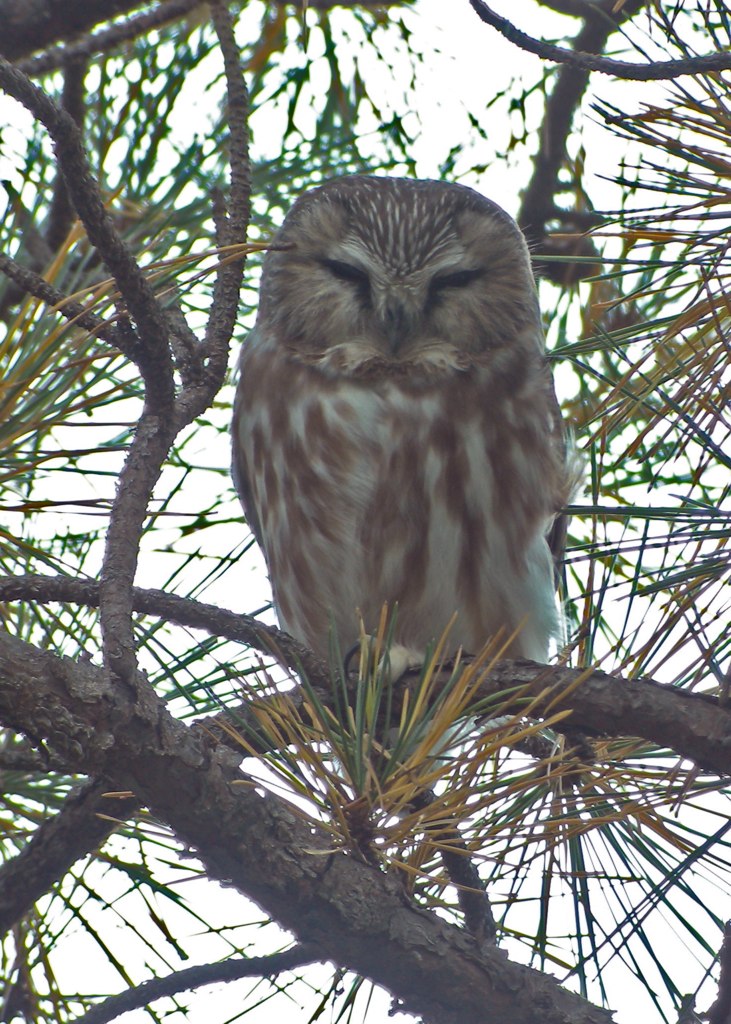
Isra perched high in a pitch pine
Isra has a routine going for her that she repeats every night we have been tracking her. Soon after dark, she leaves her roost and becomes very active, flying back and forth along the King's Gap/Michaux State Forest border. She keeps us on our toes as we run around, trying to figure out where she is off to. Several times she has completely ditched us, only to show up back at near the banding station at King's Gap.
After flying around for several hours, presumably hunting, she often settles down for several hours and gives us some time to relax and enjoy the night sounds other than our feet crunching the newly fallen leaves.
Isra often stays relatively still until shortly before dawn, when she starts flying again and soon ends up in the pitch pine where she will roost for the day. As the sun comes up, we get to go search for the roost site so we know where to find her the following evening.
Mornings are great at King's Gap because there are steady streams of migrating birds flying around. Currently, American Robins steal the show but grackles and juncos are also common in large flocks.
Friday, October 30, 2009
Esmeralda and her food
I don't have too much time before I need to get some sleep but I wanted to post this picture of our newest owl with a transmitter, Esmeralda. She saved our night of tracking last night because we were able to track her from our cars when the weather turned sour and it started misting heavily and then raining. The other saw-whet we are following, Isra, hangs out in the area south of the King's Gap banding station and is quite impossible to track from a car.

Thursday, October 29, 2009
Wet, wet, wet - dry! - wet, wet...
The weather's really been against us this season, as one wet system after another has squatted over the Northeast. This has been especially true for weekends, meaning that most of the groups scheduled to visit the banding stations have either had to cancel, or sit through damp, owless evenings.
We have had some bright spots. Last Sunday night, Oct. 25, conditions were nearly perfect. A cold front had passed through the night before with wind, rain and a lot of falling leaves, but the 25th was cold and calm, with only a half-moon's worth of light. I was running our Hidden Valley site, and after empty nets at the first check, the owls started coming fast and furious, seven or eight at a time. By the time we closed up at 2:30 a.m. we had 24 new saw-whets. In all, we're at about 150 owls for the season - a slow start that puts us behind the average count for this date.
One of the most exciting aspects of our work is the capture of an owl that someone else banded - a foreign recap, of which we've had seven already this year. One of those was an interstation recovery from our own project, a saw-whet banded as a second-year female by Jan Getgood at her home near Hummelstown Nov. 9, 2005, and recaptured on Oct. 20 of this year at our Small Valley site - five-year-old owl, a very respectable age for a saw-whet. (The new longevity record for the species, just set this week by a saw-whet banded and recaptured in Trinity, California, is 9 years old.)
Among the other recoveries whose origins we know were owls captured at King's Gap this month originally banded in Hilliardtown Marsh, ON in 2007; Shirley's Bay, ON, last fall; and the Mohonk Preserve in southeastern New York in 2008. One owl recaptured at Small Valley was banded in Brockway, PA, by Keely Roen's Penn State group last November.
Two of our owls have likewise been reported elsewhere - a Hidden Valley bird from 2007 recaptured at Villa-Marie, Quebec, and a 2008 Hidden Valley owl at Shirley's Bay, ON.
The telemetry work has been a slow push as well for Drew, Kim and Hannah, who are doing yeoman's work under trying circumstances. The weather hasn't helped, and neither has Isra, the saw-whet we're currently tracking - an owl with a talent for leading the crew all over creation, then settling down in the one part of South Mountain designed to confound a radio signal.
Typical was the other night - no matter where Kim positioned herself, she couldn't get a good bearing on the bird, who kept moving around so that Hannah and Drew up on top of the ridge likewise had to keep shifting to new locations. Meantime, Drew was watching on his smart phone as a large area of rain was sweeping in the from southwest. About 4 a.m. it started to drizzle, but it looked from the radar as though the rain would miss them.
Not really. Instead, they found themselves in a driving downpour, slogging 20 minutes back to the car through dripping vegetation. "One of those nights," Drew said later, "but at least we got two extra hours of sleep." Ah, the glamor of wildlife research.
If you're in central Pennsylvania this weekend, be sure to join us for the annual Halloween Owls program at the Ned Smith Center, starting at 7 p.m. Saturday, Oct. 31. We'll be running nets to catch saw-whets (weather permitting), and our good friends from the Shaver's Creek Environmental Education Center will be there with a variety of live owls. It's always fun, and very kid-friendly.
We have had some bright spots. Last Sunday night, Oct. 25, conditions were nearly perfect. A cold front had passed through the night before with wind, rain and a lot of falling leaves, but the 25th was cold and calm, with only a half-moon's worth of light. I was running our Hidden Valley site, and after empty nets at the first check, the owls started coming fast and furious, seven or eight at a time. By the time we closed up at 2:30 a.m. we had 24 new saw-whets. In all, we're at about 150 owls for the season - a slow start that puts us behind the average count for this date.
One of the most exciting aspects of our work is the capture of an owl that someone else banded - a foreign recap, of which we've had seven already this year. One of those was an interstation recovery from our own project, a saw-whet banded as a second-year female by Jan Getgood at her home near Hummelstown Nov. 9, 2005, and recaptured on Oct. 20 of this year at our Small Valley site - five-year-old owl, a very respectable age for a saw-whet. (The new longevity record for the species, just set this week by a saw-whet banded and recaptured in Trinity, California, is 9 years old.)
Among the other recoveries whose origins we know were owls captured at King's Gap this month originally banded in Hilliardtown Marsh, ON in 2007; Shirley's Bay, ON, last fall; and the Mohonk Preserve in southeastern New York in 2008. One owl recaptured at Small Valley was banded in Brockway, PA, by Keely Roen's Penn State group last November.
Two of our owls have likewise been reported elsewhere - a Hidden Valley bird from 2007 recaptured at Villa-Marie, Quebec, and a 2008 Hidden Valley owl at Shirley's Bay, ON.
The telemetry work has been a slow push as well for Drew, Kim and Hannah, who are doing yeoman's work under trying circumstances. The weather hasn't helped, and neither has Isra, the saw-whet we're currently tracking - an owl with a talent for leading the crew all over creation, then settling down in the one part of South Mountain designed to confound a radio signal.
Typical was the other night - no matter where Kim positioned herself, she couldn't get a good bearing on the bird, who kept moving around so that Hannah and Drew up on top of the ridge likewise had to keep shifting to new locations. Meantime, Drew was watching on his smart phone as a large area of rain was sweeping in the from southwest. About 4 a.m. it started to drizzle, but it looked from the radar as though the rain would miss them.
Not really. Instead, they found themselves in a driving downpour, slogging 20 minutes back to the car through dripping vegetation. "One of those nights," Drew said later, "but at least we got two extra hours of sleep." Ah, the glamor of wildlife research.
If you're in central Pennsylvania this weekend, be sure to join us for the annual Halloween Owls program at the Ned Smith Center, starting at 7 p.m. Saturday, Oct. 31. We'll be running nets to catch saw-whets (weather permitting), and our good friends from the Shaver's Creek Environmental Education Center will be there with a variety of live owls. It's always fun, and very kid-friendly.
Wednesday, October 21, 2009
Too busy to write

George Gress banding a saw-whet at Hidden Valley (©Scott Weidensaul)
It feels as though we've gone from 0 to 60 around here in no time flat. After a miserable weekend Oct. 15-17, with tons of wind-driven rain, and some snow at the higher elevations, the skies cleared out Sunday, Oct. 18 and we started catching owls - 32 that night, 17 of them at Hidden Valley alone.
All three sites are attaching geolocators, and we've deployed about 30 of the 190 we need to send out this fall. And we've radio-tagged two more saw-whets, which the crew nicknamed Elvira (a hatching-year female) and Isra (a second-year female). Xena, which was tagged Oct. 12, seems to have left the area, but Skreech the screech-owl remains on its territory near King's Gap.
Thank goodness for Skreech. Last weekend, as the worst of the weather was descending, our colleagues Nick and Mary Freeman, who study breeding owls (including saw-whets) in the mountains around Los Angeles, flew in from California. Their first night of banding was canceled due to rain, and Saturday night we were determined to get them out for radio-tracking - except that Xena had bugged out in the rain the night before.
So it was Skreech to the rescue. For three hours in clammy mist and occasionally heavy rain, we gave Mary and Nick a tutorial in basic radio triangulation techniques, along with tips on getting your data sheets soaked, holding dual umbrellas to shield the tracker, and avoiding drips of icy, barely-above-freezing rain down the back of your neck. Mary asked, "Is Pennsylvania always butt-freezing cold?" At this time of the year, often.
Fortunately, they were still in town the next day when the skies cleared and north winds began to blow. They had a few great hours of hawkwatching at Waggoner's Gap, then joined us at Hidden Valley for our 17-bird night.
Since then, the weather has grown considerably less butt-freezing, and with Indian summer, not surprisingly the number of owls has dropped off, down to five to eight per site each night. Still, we're up to 75 for the season - below average but making up ground rapidly.
Tuesday night the telemetry crew were chasing Isra up in Michaux State Forest. Between the canopies of the trees, they could see patches of star-splashed sky - and the whizzing, bright trails of the Orionid meteor shower, which graced the final hours of the night before they put Isra to bed, and went off to get some sleep themselves.
Subscribe to:
Posts (Atom)
