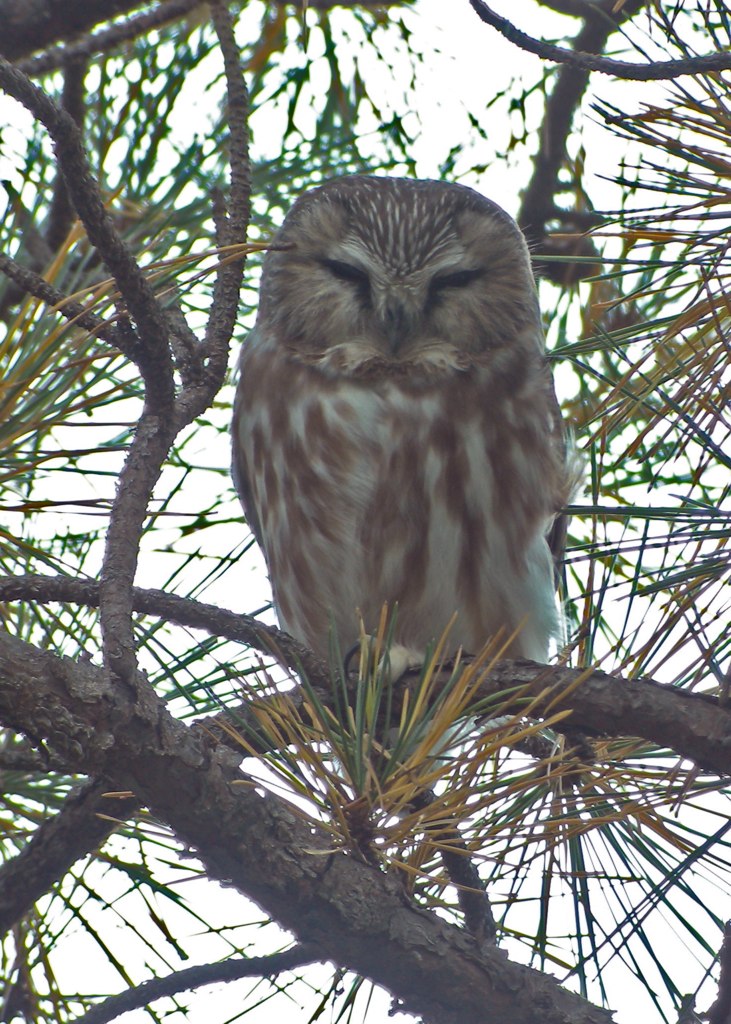
Friday, November 4, 2011
Watching the nets...and the radar
Tuesday, October 25, 2011
Fifteen years, and counting
They say time flies when you're having fun, and that certainly true for the Ned Smith Center's owl research program. It's difficult for me to believe that this marks our 15th year of studying the ecology and migration of northern saw-whet owls.
The NSCNA project was one of several that began in the fall of 1997 with modest assistance from the Pennsylvania Wild Resource Conservation Fund, whose symbol is the saw-whet. The WRCF allocated about $9,000 to buy enough nets, audiolures and banding equipment to set up nine owl-banding sites across the state, all operated by volunteer banders.
The center's first site was at a private cabin along Mahantongo Mountain in northern Dauphin County, and that year the crew was thrilled to catch 24 owls. The next year we'd moved our operations to the top of Berry Mountain, and the catch jumped to 73 – we thought we'd figured it all out.
The following year, 1999, we began running three fulltime stations – Berry Mountain, one on South Mountain in Cumberland County, and one along Second Mountain in Schuylkill County. That year also marked one of the periodic irruptions that bring huge numbers of saw-whets south, and we banded 727 owls – almost 10 times what we'd caught at Berry Mountain the year before.
Since then, we've banded nearly 6,000 owls – as well as conducting nearly a decade of intensive radio-telemetry work to study their roost sites and nocturnal habits; collaborative studies with researchers looking at the spread of avian influenza, West Nile virus and tick-borne pathogens; deployment of high-tech geolocators to try (thus far with limited success) to study long-term owl movements; and much more.
The only thing making that possible is the incredible commitment of our crew of volunteer banders and assistants – 18 federally licensed banders and 85 assistants, who in total give between 5,000 and 6,000 person-hours a year to this project.
We opened our sites Oct. 3 for this, our 15th season, with as much enthusiasm as we had all those years ago. It's been a slow start, though, in part because of the warm and wet weather with persistent southerly winds, and in part because we've been expecting this to be a slow year, a low point in the saw-whet's population cycle.
How slow? At this point last year – which was just a little above average – we'd caught 146 saw-whets. This year, all three of our sites together have netted just 10, six of them in the past three nights.
I was sharing this news with a group of visitors the other night, and someone raised their hand and asked, "Aren't you alarmed that the owls are declining so badly?" No; this is normal for saw-whet owls, a species that undergoes huge and predictable fluctuations from year to year.
Like many northern raptors, their fortunes are tied to the abundance of their prey (small rodents), most of which have roughly four-year population cycles themselves. When the voles and mice are common, the owls produce a bumper crop of babies – and we have a flight like the one in 2007, when we netted almost 900 owls.
When the rodent cycle bottoms out, as it did this year, the owls produce few chicks, and we get a year like 2006, when we caught barely 200 saw-whets. This fall is shaping up to be one of those years.
The good news is that the mouse cycle is on the way up again, and next year ought to be one of those periodic irruptions, when the skies are filled with migrant owls. And whether it's a good flight ot a meager one, each new season helps us better understand what's driving owl migration – which is why we spend our nights in the woods.
Scott Weidensaul
Research director, Ned Smith Center for Nature and Art
Wednesday, November 18, 2009
Was it something we said?
So Monday night they tagged the only owl the King's Gap banding crew caught, a hatching-year female. They bandied around a couple of delicious food-themed names but thought better of it. "We were going to name it Meatballs, but we decided saying that name all night might make us hungry." Drew told me when he called from the woods around 9 p.m. with the news. "We figured it wouldn't be as big a problem with an owl named Tofu," so that's what they went with.
Instead, Tofu posed other problems. After tracking her for several hours near the banding station, the telemetry team followed her as she moved south over the ridge to Cold Spring Hollow, checking on her position every 10 minutes. And then around 3 a.m., between position checks, she simply disappeared. The crew fanned out for the rest of the night, checking from high points throughout Michaux State Forest, but Tofu had left the buffet.
Last night they tried for another telemetry owl at King's Gap, but came up dry - while we had owls at the other two sites, there were none caught at KG. We'll try again tonight.
We're up to 358 saw-whets and five screech owls for the season, still getting two or three a night at each station. In the past week we've had a number of foreign birds come into our nets ("foreign" meaning banded at another site), while several of our owls have shown up elsewhere.
Among the owls we've caught were birds banded at Tadoussac, Quebec in 2007; several from Glenn Proudfoot's operation at the Mohonk Preserve in southeastern New York; and three from Virginia - an owl banded in 2004 in the highlands of western Virginia, one banded in February 2008 in Shenandoah River State Park, and one banded in November 2007 at Kiptopeke on the southern tip of the Delmarva Peninsula. We've caught several other owls for which there was no data in the Banding Lab database.
Our owls have shown up in the past week in South Hadley, Massachusetts; Elk Neck State Park in northern Maryland; and several at Lamb's Knoll in the Catoctin Mountains of western Maryland.
We've also - finally - reached the end of the line with our geolocator project. Last night, Guy Ubaghs deployed the last two at Small Valley - 178 of the tiny tracking devices, which are continuously recording data that will allow us to determine the owls' daily latitude and longitude once we start recovering some of them next year.
None of this would have been possible without an extraordinary effort on the part of our banding crew, especially the banders from Small Valley, who double-teamed most nights this fall so one person could band and the other deploy up to 10 geolocators per night.
A few geolocator-tagged owls have shown up in our nets, and Sunday night I got a call from Dave Darney, who bands saw-whets on the Allegheny Front in Somerset County. He'd just caught a geo-tagged owl we released Nov. 6 at our Small Valley site, about 110 miles to the east. After checking the owl (it and its harness were both in fine shape), he released it - we're hoping to get up to two full migration cycles from the geolocators, so there was no point in taking it off after just nine nights and a relatively short distance traveled.
Monday, November 16, 2009
Feist
Here is a a picture of Fiest, being held by Alex L. before being released. We were tracking our other owl, Fang, but kept checking up on Feist to make sure she was around. In the morning we found her roosting high up in a white pine. We have been spoiled with the owls choosing pitch pines to perch in where they are often easier to see. White pines have denser needles and limbs, so a saw-whet that is perched high is hard to spot.
Friday, November 13, 2009
Busy week
Normally, our peak flights come right around Halloween, but a full moon Nov. 2, and a lot of unseasonably mild air, seems to have delayed the migration. The couple of big nights we had on Oct. 18 and 25 tend to mask the trend, but if you look at our capture totals in seven-night blocks, here's what you find:
Oct. 1-7: 0 saw-whets
Oct. 8-14: 9
Oct. 15-21: 74
Oct. 22-28: 60
Oct. 29-Nov. 4: 63
Nov. 5-11: 98
Last night, the 12th, we had another 21 owls between the three sites, and reports from the north make me suspect there are more to come. Holiday Beach in Ontario, across the river from Detroit, is still getting 20-30 owls a night, and Prince Edward Point, on the northeast shore of Lake Ontario, banded 500+ owls this season, of which only two have been recaptured - we normally get a lot of PEPtBO's birds, suggesting they're still to our north.
We've had a bunch of interesting foreign recaptures this week as well. Two have come from Glenn Proudfoot's operation at the Mohonk Preserve in southeastern New York, one from Quebec in 2007, and another from Virginia in 2008. We also caught another old saw-whet, banded as a hatching-year (juvenile) in 2004 by Clair Mellinger in Bergton, VA - which was quite a coincidence, because in 2005 we caught another of Clair's owls, banded that same night the year before.
So far we've caught 22 foreign owls, while eight of our birds have been reported from other sites. Both totals are a little on the low side, especially the latter.
The telemetry crew has been busy all week. Esmeralda had been hanging out south of King's Gap on private land, so they focused their attention on Isra, who has been a real challenge to track, covering a much larger area than past owls have done this year or last. Here's an example of one partial night's tracking, from dusk at 18:00 hours until about 2 a.m.; the polygons are color-coded from pale to dark to make it easier to follow her movements over time.

That night, she covered an area about twice the size of a typical half-night track for one of our 2008 owls. Whether this is just an expression of her personality, her hunting skill (or lack thereof) or a general scarcity of prey, we can't yet say.
On Tuesday night, I joined the tracking crew to follow Isra around Buck Ridge and upper King's Gap Hollow. That night she was behaving herself a little more, making it easier for Hannah and Drew to track her, although Kim had to keep shifting to get a clear bearing.
That same night, the KG banding crew put another radio on a new owl, an adult female nicknamed Fang (hey, just because we think they're cute doesn't mean they aren't ferocious little predators). Two nights later, they tagged an HY female dubbed Feist, because it pulled so much blood from Drew during harnessing.
The timing was perfect, since both Esmeralda and Isra left the same night. Isra in particular had been a real trouper, sticking around since Oct. 19 and giving us a lot of data.
We're almost done deploying our geolocators - out of 178, we have about 15 left. None of the geolocator-tagged owls have turned up at other sites, but then, only one of the 326 owls we've banded so far this year have been recaptured by another site - the remarkable "Wrong Way" Corrigan of an owl I wrote about last weekend.
Sunday, November 8, 2009
Wrong Way Corrigan

In 1938, aviator Douglas Corrigan made a transcontinental flight from California to Brooklyn. Flush with his success, he wanted to try another nonstop flight immediately, this time across the Atlantic from New York to Europe. He'd been trying to get permission for the flight for two years, but his rickety plane, which was basically held together with spit and baling twine, was not considered safe, and his flight plan was again denied.
Corrigan took off, supposedly to return home to California. Instead, he landed 28 hours later in Belfast, Ireland, and until his dying day he swore that he'd simply gotten lost. Manhattan threw him a tickertape parade, the New York Post ran a backwards banner headline that read HAIL WRONG WAY CORRIGAN, and a legend (and an expression) was born.
It looks like we have our own Wrong Way Corrigan. On Oct. 26, my crew and I banded 24 saw-whets at our Hidden Valley site in Schuylkill County, just north of the town of Friedensburg. The last owl of the night was an after-second-year female (meaning she was at least three years old, possibly older).
Imagine my surprise when I learned that this same owl was recaptured Friday night - not south of us, as you'd expect, but in Allegany State Park near Salamanca, New York, at a site run by bander Tom LeBlanc.
That's almost 170 miles to the northwest - the wrong way for any bird that's supposed to be migrating south for the winter.

The odd thing is, this isn't all that odd. Coincidentally, the day before this recapture, a number of saw-whet banders had been discussing birds moving in unexpected directions - speculating whether this was a result of immature birds undertaking a form of dispersal flight, or a manifestation of the nomadism many of us suspect is a constant theme in saw-whet life.
The subject arose when banders in Massachusetts twice recaptured (at two different sites) an owl banded in a previous fall in Kentucky. Some of our birds banded in Pennsylvania have subsequently been caught in Illinois, Michigan and Ohio, and we've caught owls banded in Michigan, Wisconsin and western Ontario. But in most of these cases, a year or more elapsed between banding and recapture.
Last year, however, another of our owls (also an adult) made a long flight to the northeast, showing up 118 miles to the northwest a week after we banded her, in nets run by our colleague David Hauber near Hebron, PA.
So what's going on? I tend to think this has less to do with "lost" owls and more to do with an evolutionary approach that uses nomadic behavior to find areas of abundant food, both during breeding and nonbreeding seasons. After all, historians like to point out that whatever his claims to the contrary, Corrigan certainly knew exactly where he was flying.
There is circumstantial evidence to suggest that saw-whets are highly nomadic during the nesting season - that unlike most birds, which return faithfully to the same nesting territory every year, saw-whets may slosh around the boreal forests of Canada and the northern United States - maybe in Quebec one year, and the next in central Ontario, where the mast crop (and thus the rodent population) is higher. Then in the fall, instead of coming south through New York and Pennsylvania, the owl crosses through the Great Lakes region into Michigan and Illinois.
They may also be nomadic in the nonbreeding season, too, shifting widely across the landscape. While rare among raptors, such constant wandering is common among many boreal birds, like crossbills and pine siskins.
This is just speculation, but our geolocator study may shed some light on these questions. Because the data loggers will collect information from which we can plot the rough daily position of the owl for up to two years, we may finally get some hard evidence to explain whether they are as nomadic and unpredictable as these rare banding encounters suggest.
Unfortunately, because I was shorthanded the night we caught this owl, I didn't fit her or most of the other saw-whets that night with geolocators. But I suspect the owls we have fitted with the devices will provide some real surprises when we start recovering some of the geolocators next year.
Thursday, November 5, 2009
Owl Nightlife, or... what does a saw-whet do at night?
Isra has a routine going for her that she repeats every night we have been tracking her. Soon after dark, she leaves her roost and becomes very active, flying back and forth along the King's Gap/Michaux State Forest border. She keeps us on our toes as we run around, trying to figure out where she is off to. Several times she has completely ditched us, only to show up back at near the banding station at King's Gap.
After flying around for several hours, presumably hunting, she often settles down for several hours and gives us some time to relax and enjoy the night sounds other than our feet crunching the newly fallen leaves.
Isra often stays relatively still until shortly before dawn, when she starts flying again and soon ends up in the pitch pine where she will roost for the day. As the sun comes up, we get to go search for the roost site so we know where to find her the following evening.
Mornings are great at King's Gap because there are steady streams of migrating birds flying around. Currently, American Robins steal the show but grackles and juncos are also common in large flocks.
Friday, October 30, 2009
Esmeralda and her food
Thursday, October 29, 2009
Wet, wet, wet - dry! - wet, wet...
We have had some bright spots. Last Sunday night, Oct. 25, conditions were nearly perfect. A cold front had passed through the night before with wind, rain and a lot of falling leaves, but the 25th was cold and calm, with only a half-moon's worth of light. I was running our Hidden Valley site, and after empty nets at the first check, the owls started coming fast and furious, seven or eight at a time. By the time we closed up at 2:30 a.m. we had 24 new saw-whets. In all, we're at about 150 owls for the season - a slow start that puts us behind the average count for this date.
One of the most exciting aspects of our work is the capture of an owl that someone else banded - a foreign recap, of which we've had seven already this year. One of those was an interstation recovery from our own project, a saw-whet banded as a second-year female by Jan Getgood at her home near Hummelstown Nov. 9, 2005, and recaptured on Oct. 20 of this year at our Small Valley site - five-year-old owl, a very respectable age for a saw-whet. (The new longevity record for the species, just set this week by a saw-whet banded and recaptured in Trinity, California, is 9 years old.)
Among the other recoveries whose origins we know were owls captured at King's Gap this month originally banded in Hilliardtown Marsh, ON in 2007; Shirley's Bay, ON, last fall; and the Mohonk Preserve in southeastern New York in 2008. One owl recaptured at Small Valley was banded in Brockway, PA, by Keely Roen's Penn State group last November.
Two of our owls have likewise been reported elsewhere - a Hidden Valley bird from 2007 recaptured at Villa-Marie, Quebec, and a 2008 Hidden Valley owl at Shirley's Bay, ON.
The telemetry work has been a slow push as well for Drew, Kim and Hannah, who are doing yeoman's work under trying circumstances. The weather hasn't helped, and neither has Isra, the saw-whet we're currently tracking - an owl with a talent for leading the crew all over creation, then settling down in the one part of South Mountain designed to confound a radio signal.
Typical was the other night - no matter where Kim positioned herself, she couldn't get a good bearing on the bird, who kept moving around so that Hannah and Drew up on top of the ridge likewise had to keep shifting to new locations. Meantime, Drew was watching on his smart phone as a large area of rain was sweeping in the from southwest. About 4 a.m. it started to drizzle, but it looked from the radar as though the rain would miss them.
Not really. Instead, they found themselves in a driving downpour, slogging 20 minutes back to the car through dripping vegetation. "One of those nights," Drew said later, "but at least we got two extra hours of sleep." Ah, the glamor of wildlife research.
If you're in central Pennsylvania this weekend, be sure to join us for the annual Halloween Owls program at the Ned Smith Center, starting at 7 p.m. Saturday, Oct. 31. We'll be running nets to catch saw-whets (weather permitting), and our good friends from the Shaver's Creek Environmental Education Center will be there with a variety of live owls. It's always fun, and very kid-friendly.
Wednesday, October 21, 2009
Too busy to write

It feels as though we've gone from 0 to 60 around here in no time flat. After a miserable weekend Oct. 15-17, with tons of wind-driven rain, and some snow at the higher elevations, the skies cleared out Sunday, Oct. 18 and we started catching owls - 32 that night, 17 of them at Hidden Valley alone.
All three sites are attaching geolocators, and we've deployed about 30 of the 190 we need to send out this fall. And we've radio-tagged two more saw-whets, which the crew nicknamed Elvira (a hatching-year female) and Isra (a second-year female). Xena, which was tagged Oct. 12, seems to have left the area, but Skreech the screech-owl remains on its territory near King's Gap.
Thank goodness for Skreech. Last weekend, as the worst of the weather was descending, our colleagues Nick and Mary Freeman, who study breeding owls (including saw-whets) in the mountains around Los Angeles, flew in from California. Their first night of banding was canceled due to rain, and Saturday night we were determined to get them out for radio-tracking - except that Xena had bugged out in the rain the night before.
So it was Skreech to the rescue. For three hours in clammy mist and occasionally heavy rain, we gave Mary and Nick a tutorial in basic radio triangulation techniques, along with tips on getting your data sheets soaked, holding dual umbrellas to shield the tracker, and avoiding drips of icy, barely-above-freezing rain down the back of your neck. Mary asked, "Is Pennsylvania always butt-freezing cold?" At this time of the year, often.
Fortunately, they were still in town the next day when the skies cleared and north winds began to blow. They had a few great hours of hawkwatching at Waggoner's Gap, then joined us at Hidden Valley for our 17-bird night.
Since then, the weather has grown considerably less butt-freezing, and with Indian summer, not surprisingly the number of owls has dropped off, down to five to eight per site each night. Still, we're up to 75 for the season - below average but making up ground rapidly.
Tuesday night the telemetry crew were chasing Isra up in Michaux State Forest. Between the canopies of the trees, they could see patches of star-splashed sky - and the whizzing, bright trails of the Orionid meteor shower, which graced the final hours of the night before they put Isra to bed, and went off to get some sleep themselves.
Friday, October 16, 2009
Geolocators

The geolocators are miniature, backpack-mounted data-loggers, continuously monitoring light levels for up to two years, from which we can determine the rough latitude and longitude of the migrating owl. The tiny units are custom built by the British Antarctic Survey, and have been used to study the migrations of wood thrushes and purple martins, but never saw-whet owls.
This week we began fitting saw-whets with geolocators at our Hidden Valley station, and will soon be doing so at all three of our sites. The harness is made from thin, tough Teflon ribbon that figure-eights around the bird's body, holding the geolocator high in the middle of the back. A short stalk sticks up above the feathers, with the light sensor at the tip. The entire unit and stalk are encased in a light, thin shell of epoxy to protect the innards from sharp owl beaks.

(A special thanks to Marge Gibson and her staff at the Raptor Education Group in Wisconsin, who tested the geolocators and the harnesses on three of their captive saw-whets, even going so far as to create nest boxes with natural flicker- and pileated woodpecker-sized entrance holes, to make sure the sensor stalks didn't interfere with the owls' ability to enter and exit the cavities.)
We were also grateful to York University grad students Maggie McPherson and Callie Stanley for giving up their (Canadian) Thanksgiving holiday to come south to help with the work, and to give us the benefit of their geolocator experience working with thrushes and martins under Dr. Bridget Stuchbury.

From left: Callie Stanley, bander Nate McKelvie (front), Maggie McPherson, Pat Trego (rear), Nada Farah, Baha' Ishaq (rear), Ika Rani Suciharjo and Maria del Mar Contaldi. (©Scott Weidensaul)
Finally, we were delighted this week to welcome a number of the international interns from Hawk Mountain Sanctuary, which is not far from Hidden Valley. Marie del Mar Contaldi from Argentina is working on a master's on vulture and condor biology; Nada Farah from Lebanon serves as the country's Important Bird Areas coordinator; Baha' Ishaq from Palestine is an undergrad at Bethlehem University and the only licensed ringer (bander) in the Palestinian territories; and Ika Rani Suciharjo from Indonesia is a high school biology teacher with extensive experience in environmental conservation. As you can see from the picture, they were thrilled with their first encounters with saw-whets.
Tuesday, October 13, 2009
Xena, visitors, and better things to come
Although we only caught two saw-whets Monday night - one at Small Valley and one at King's Gap - the latter bird, an immature female, left with a radio transmitter and a nickname that intern Hannah Panci came up with - Xena, for the TV warrior princess, in recognition of this little fighter's spirit. From her release until about 3 a.m., Xena stayed on the ridgetop near the banding station, then moved down the west side of the mountain, staying put until the tracking crew left her at 7:30 a.m.
Although we didn't have any owls at Hidden Valley, we did have a couple of interesting guests, who will be with us all week. Maggie McPherson and Calandra (Callie) Stanley are grad students at York University in Toronto, studying with Dr. Bridget Stuchbury, a specialist in songbird migration, and one of the first scientists to use geolocators like the ones we'll be deploying this fall.
Maggie and Callie are both working with wood thrushes and purple martins at Bridget's study site in northwestern Pennsylvania, and Callie is also tagging thrushes on their wintering grounds in Costa Rica. They've given up their fall break to drive down from Toronto and spend the week helping us with our geolocator work - and spend some time with owls, since Maggie began banding NSWOs in ninth grade in Ontario, working the Timiskaming stations run by Bruce Murphy.
Speaking of whom, Bruce posted a happy warning to those of us to the south that the wait may soon be over. Friday night they had 95 saw-whets, one of their biggest nights ever, although high winds have cut their catch rate since then. They're up to 390 for the season, and he thinks we in the south will have the roughly average flight I've been expecting this year, which for our sites would mean around 450-500 owls.
Saturday, October 10, 2009
Slow going
Part of the reason may lay with the relatively mild, windy, showery weather we've had here in the mid-Atlantic, but I suspect even more of the problem lies to our north - a series of storms that have paraded across southeastern Canada, slowing down the migration.
However, there's a dramatic change in the weather coming over the next few days, with an Arctic air mass plunging down through the Great Lakes and East, with predictions of snow downwind of the lakes and on the higher elevations of New England. We're expecting this cold snap to generate the first good push of owls in our region, perhaps as early as tonight.
Meantime, our radio-telemetry crew has been focusing its attention on the screech-owl we tagged last month, and they're taking a weekend off after six nights of triangulation. Skreech, as they nicknamed the bird, has been hunting the western side of King's Gap State Park and adjacent portions of Michaux State Forest, moving around frequently enough to keep Drew, Hannah and Kim on their toes. Once we start getting saw-whets, they'll switch their attention to them, but we'll continue to keep track of Skreech in the weeks ahead, too.
Monday, October 5, 2009
Skreech and the full moon
Poets, lovers and songwriters like full moons. Owl researchers, not so much.
For whatever reason, the number of owls caught drops dramatically during a full-moon period, which may explain (along with the lovely, mild weather) why we're 0 for 4 with saw-whets - having opened our 2009 banding operation four nights ago, we still have yet to net our first saw-whet owl.
This isn't unusual - it's often pretty slow the first week of the season, and the migration doesn't peak until about Halloween. In each case, though, the crews at our three sites had plenty to divert to their attention, even in the absence of owls. At Hidden Valley Saturday night there was a fireworks display in the valley, while at Small Valley (where the caretaker has been seeing three large black bears) the volunteers were just glad nothing went bump in the night.
At King's Gap, we actually did catch an owl last week - not a saw-whet, but I'll let Hannah Panci, one of our research interns, pick up the story:
"Meet our red-morph eastern screech-owl (a hatch-year bird, sex unknown), given a gangster name of “Skreech.” After many tries over the course of three nights, Scott, Drew, Kim and I managed to lure it into the net last Wednesday night. Fitted with the newest model of radio transmitter backpack, it was released, and our little research team tracked it until 3 am. We found it again yesterday, sneakily roosting in the open about 30 feet off the ground. We’ll be tracking Skreech throughout the fall, both as telemetry practice and to see how its movements may affect any tagged saw-whets we are following. So look for more updates!"
That's Hannah's photo of Skreech, which we aged as a hatching-year bird - meaning it was born earlier this year, and is entering its first winter - by looking at its feather molt, and the pattern of pale scalloped markings on its primary wing coverts, among other clues. Unlike the migratory saw-whets, we're expecting Skreech to stay fairly close to its banding site on top of South Mountain, although as a young bird, it may still be drifting about, trying to establish a permanent territory. Once it does, though, the bird should sink down roots and stay put for the rest of its life.
Monday, September 28, 2009
Reptilian preview

Yes, I know this blog is about owl research...so why is that timber rattlesnake staring at you?
Last week, our 2009 research crew arrived and started training - and part of their training regimen was two days of radio-tracking rare timber rattlers on South Mountain, the same area where they'll be tracking owls. Last Thursday morning we joined state DCNR biologist Aura Stauffer (also a longtime volunteer member of our banding crew) to seek out several of the rattlers that the state tagged with implanted radio transmitters this summer.
Eastern timber rattlers have been on the ropes for years, with habitat fragmentation and persecution sadly reducing the population of this shy, docile reptile in Pennsylvania, to the point where it's a candidate for state endangered species listing. (There's more information about their ecology and status here.)
The South Mountain population is especially threatened, surrounded as it is by a sea of agriculture and development.
Aura led research tech Drew Weber, interns Hannah Panci and Kim Romano, me and my 15-year-old nephew Connor (who has helped with our banding and tracking since he was little) up into the rain-damp woods. Hannah, who is new to telemetry, took the receiver and yagi antenna, and with Aura's help directed us up through thick oak and pine woods with a dense understory of mountain laurel. This late in the season, Aura was expecting the snakes to move from their foraging areas to near their hibernacula - the winter den sites whose locations are unknown, and a major focus of the study.
The signal beeped more and more loudly, and Aura announced that we were getting close. Although we were all (except Aura) wearing bite-proof leggings, we watched our feet, while Aura used her snake hook to knock down some greenbrier vines. We paraded single file uphill, but just as Hannah stopped, turned, and said, "I think we walked past it," Connor gasped and pointed at Drew's feet.
The rattler, a large dark-morph male, was less than a foot from Drew - but typical for the species, it never rattled or showed the slightest aggression. Neither did the next one we tracked, which was a few hundred meters away, or a third that Kim found around lunchtime, a stunning yellow-morph female (above) curled up in the sun in a recent timber cut, even when I was lying two feet away for a better camera angle. Aura's stepped directly on rattlesnakes a few times and not been bitten. If only people showed as much tolerance for rattlers as the snakes do for people.
The highlight of the day, however, was the last stop, a small rock field deep in the woods. Walking in while Drew tracked the signal, I all but stepped on an untagged rattlesnake that did give a warning buzz as it slid down a chipmunk hole. Then we began to walk carefully up the slope of the rocks, where Aura pointed out five or six females and 14 newborn babies, known as neonates.
Suck rock fields are rookeries - sites where gravid females gather all summer to bask in the sun, not eating, only moving from sun to shade to keep their internal temperature perfectly balanced for the growing embryos. Then each female gives birth to about half a dozen babies around Labor Day, and the family remains together for a short while.

Rookery rocks are one place where rattlesnakes buzz more often than not, and the rocks were alive with the cicada-like rattles. The adult females slid underground quickly, just poking out to look at us, but the babies were curious, sometimes coming closer for a better look.
The reproductive cycle of the timber rattlesnake is glacial. A female mates one year, gives birth the next, and may have to take a year or two off before mating again to rebuild her energy reserves. A Pennsylvania rattler may only reproduce a couple of times in her life, and at the northern edge of their range, in the Adirondacks and southern New England, she may get only one chance to give birth.
Knowing the odds arrayed against this quiet, badly misunderstood species, it was a special privilege to see so many rattlers in one day, including a new generation facing an uncertain future.
Sunday, September 27, 2009
Ready, set...

Although it's been six months since we wrapped up our winter radio-tracking in April, we haven't been idle - in fact, we're a few days away from launching by far the most ambitious season of saw-whet owl research since the Ned Smith Center started studying these remarkable birds 13 years ago.
Once again, we'll be operating three banding sites through October and November - Hidden Valley in western Schuylkill County, PA; Small Valley in northern Dauphin County; and King's Gap in southern Cumberland County on South Mountain. Manning these stations will be 16 federally licensed banders and about 85 volunteers (which is a bit of misnomer; everyone on the banding crew is a volunteer).
We know from long experience that saw-whet owls are cyclical, and we're expecting a better season than last year's stinker total of 229 owls, but nothing like the record 900+ we had in 2007. I'm predicting a roughly average 475 owls, and would love to find that I low-balled it.
We also will be completing the second year of our two-year nighttime activity range study at King's Gap and adjacent Michaux State Forest. This formidable undertaking will be headed up by research technician (and '08 research intern) Drew Weber, ably assisted by this year's interns - Hannah Panci of Eagle River, WI, and Kim Romano of Lawrenceville, GA. They'll be conducting all-night radio-tracking roughly four nights a week through Dec. 18, and will be sharing their experiences through the blog.
Finally, we'll be using some of the most cutting-edge technology in avian research this year - tiny, light-sensitive geolocators, a kind of data logger invented by the British Antarctic Survey for tracking albatross migration, and now miniaturized by the BAS for use on smaller birds. (You may have seen a ground-breaking study published last winter by my colleague Dr. Bridget Stuchbury at York University in Toronto, which used geolocators to track wood thrushes and purple martins to and from their tropical wintering grounds.)
By logging daylight length and light intensity, the units record daily latitude and longitude for up to two years. We'll be deploying 190 of them this fall, and although only 10-20 of them are likely to be recovered in years ahead, those should shed unprecedented light on saw-whet owl migration. (Both the telemetry and geolocator projects have been underwritten by the generous support of the RJM Foundation, for which we're grateful.)
We'll be updating the blog every few days through the banding season, which kicks off this weekend - watch for updates, and to learn more about the project, visit the Ned Smith Center's website at www.nedsmithcenter.org.
Monday, April 13, 2009
Lexi has left the building

Well, all good things must come to an end - and almost four months to the day since we first radio-tagged her, Lexi has left the King's Gap area, presumably heading north to breed.
Since the end of February, she'd been roosting in a small grove of white pines along Yellow Breeches Creek in southern Cumberland County, and every day or two, telemetry coordinator Aura Stauffer's been checking on her. On April 8, Aura was joined by Karl Kleiner, one of our banders who is a professor at York College of Pennsylvania, and two of Karl's students, Katie Kolos and Shawn Fauth, who tracked down Lexi with Karl and Aura's help.
The next day, Aura was back, realizing that with the opening of trout season, Lexi suddenly had lots of company in her streamside retreat. Aura pointed out the owl to a couple of young boys and their father who were fishing the Yellow Breeches. "One of the boys ran over to his mom, who was fishing, and told her he just saw the smallest owl in Pennsylvania," Aura reported. "How cute!"
On Saturday, telemetry volunteers Carl and Pat Leinbach, who helped so much last fall and winter with our nighttime work, checked on Lexi and found her signal right where we expected. But by Easter morning, when Karl Kleiner and Susan Klugman checked, there was only silence, and the Leinbachs found the same later in the day. Aura was out this morning, and she confirmed what we all suspected -- Lexi was finally on her way north.
"After tracking her for four months, I will miss the little bugger," Aura said. "She has given us a lot of interesting information; not to mention a whole freezer full of owl pellets (my Mom would be appalled)."
It's been a remarkable experience to track one bird for so long, and Lexi gave us amazing insights into saw-whet winter ecology and behavior. And who knows? She may end up in our nets (or someone else's) down the road. In the meantime, we all wish her a safe migration and successful first breeding season.
There's an funny coda to this story. Carl and Pat, unwilling to give up, headed out today to try one more time for Lexi's signal in some of her other previous roost areas. They started near the pine grove, then drove toward King's Gap, using the roof antenna on their car. Near the state fish hatchery -- bingo, they got a signal. After some doubling back to confirm, they raced up to King's Gap, got out and hooked up the handheld yagi antenna. Nothing, not even near the hatchery.
Then they drove up the mountain on Cold Springs Road to Ridge Road, and along the top, they got a strong signal again. Pat turned off their Prius, and Carl got out with the yagi. Again, nothing. When they hooked up the roof antenna, again they got a strong signal - and that's when they realized that the electrical system in their Prius was fooling the receiver.
"We were tracking ourselves!" Carl said. "The Prius is a small car, but hardly qualifies as a saw-whet owl."
We couldn't ask for a better, more dedicated crew of volunteers - and now, with our two-month "autumn" research season finally wrapping up after almost seven months, it's time for us to take a rest. Thanks as well to those who've been following this blog - we'll start again come late September, with more banding, telemetry and an even more exciting new project...but we'll have more to say about that come fall, though.
Monday, March 16, 2009
Lexi's Big Day
Aura Stauffer checked on Lexi today, and found her back in her favorite spruce tree; here's a photo of her there last week in that tree, enjoying some early spring sunshine.
And here's a shot of the woman who is often behind the camera - Aura with Lexi, right after giving the young lady a new radio transmitter last week. The photo's courtesy of DCNR botanist Carrie Gilbert, who was kind enough to give Aura a hand in capturing and reharnessing Lexi - you need a minimum of four hands for the job, and while Aura's amazing, there are limits to what she can do alone.

Sunday, March 15, 2009
A Most Excellent Owl

Although I haven't posted an update in a while (I was away much of late February and early March), we're continuing to keep tabs on Lexi, that most obliging of saw-whets, who has broken all our records in becoming by far the latest-lingering telemetry owl in the eight years of this project. The previous late date for a tagged saw-whet was Feb. 21, and we're coming up on a month past that point.
I checked on Lexi yesterday, March 14, as we've been doing every day or so, and found her still roosting in a white pine thicket along Yellow Breeches Creek, about three miles northwest of the ridgetop portion of King's Gap State Park she'd used in December and January.
Last week, Aura Stauffer realized Lexi's radio signal was getting weaker - it had been almost exactly three months since we'd tagged her, and the batteries only have an expected life of 90 days. On Wednesday, Aura took advantage of Lexi's low roost to get a stepladder and hand-grab the little girl - such docility and tameness is typical of saw-whets, and Lexi in particular. Within a short time, Aura had replaced Lexi's radio with a fresh transmitter, so we should be able to keep up with her until she finally decides to head north.
When will that be? Frankly, I'm quite surprised it hasn't happened already. The peak northbound migration is usually around the beginning of March, based on our limited spring netting in years past, and we've had some perfect migration nights with warm temps and southerly winds. On the other hand, Lexi is a young bird, born in 2008, and doesn't have an established territory to which to return; adult birds of most species migrate more rapidly north in the spring than juveniles.
We're continuing to share Lexi with visitors. Last weekend, Aura took the 26 members of the Governor's Youth Sportsmen Advisory Council (who were meeting at King's Gap) to track her, and yesterday I had Hillel Brandes and Doug Miller of Penn State with me. Doug is the co-director of the university's office for remote sensing and spatial information resources, and he has some great ideas of how to combine extremely high-resolution mapping imagery with our telemetry data so we can better understand why the saw-whets are choosing the roosts and habitats that they use.
Saturday, February 21, 2009
Take-out Food

Same church, different pew, as they say...Aura checked on Lexi Friday, who was in a larger white pine within the same grove as the past three weeks, although perched only about four feet off the ground.
She was also holding a bag lunch, but for once it wasn't a Peromyscus (white-footed or deer mouse) but what appeared to be a meadow vole. Aura and I had just been talking on Thursday about how Lexi seemed to be targeting Peromyscus, even down in the valley where we'd expect voles to be more common. Maybe she overheard us, or maybe Thursdays are Vole Night at the saw-whet bistro.