Sunday, November 8, 2009

Wrong Way Corrigan


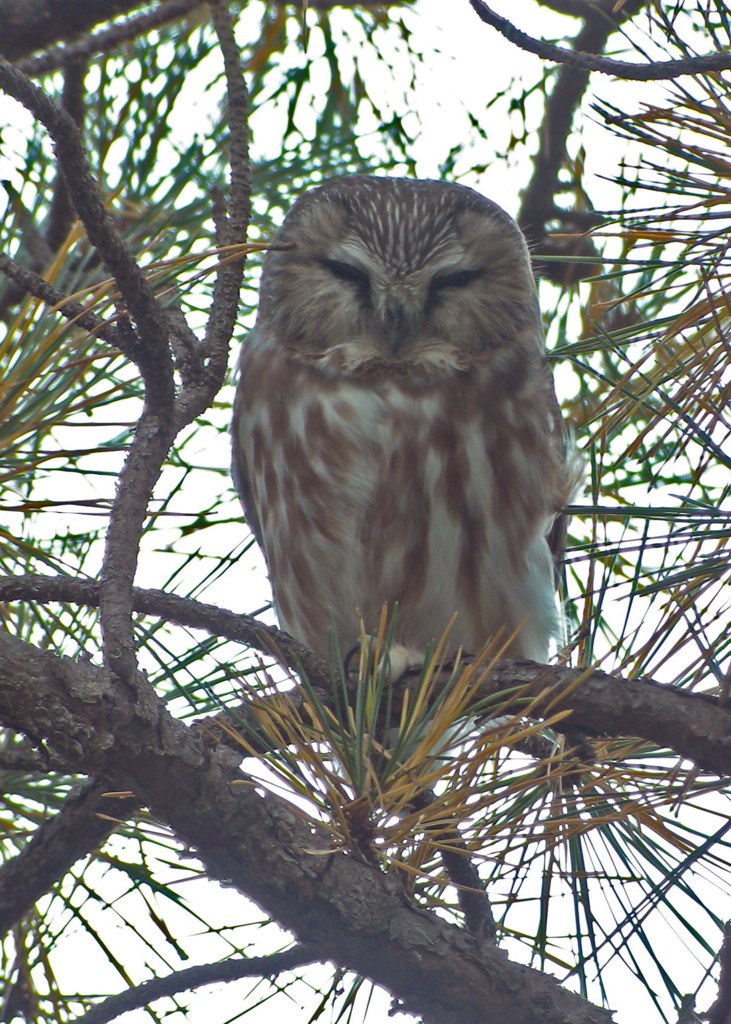
Our own Wrong Way Corrigan after her recapture (©Tom LeBlanc)

In 1938, aviator Douglas Corrigan made a transcontinental flight from California to Brooklyn. Flush with his success, he wanted to try another nonstop flight immediately, this time across the Atlantic from New York to Europe. He'd been trying to get permission for the flight for two years, but his rickety plane, which was basically held together with spit and baling twine, was not considered safe, and his flight plan was again denied.

Corrigan took off, supposedly to return home to California. Instead, he landed 28 hours later in Belfast, Ireland, and until his dying day he swore that he'd simply gotten lost. Manhattan threw him a tickertape parade, the New York Post ran a backwards banner headline that read HAIL WRONG WAY CORRIGAN, and a legend (and an expression) was born.

It looks like we have our own Wrong Way Corrigan. On Oct. 26, my crew and I banded 24 saw-whets at our Hidden Valley site in Schuylkill County, just north of the town of Friedensburg. The last owl of the night was an after-second-year female (meaning she was at least three years old, possibly older).

Imagine my surprise when I learned that this same owl was recaptured Friday night - not south of us, as you'd expect, but in Allegany State Park near Salamanca, New York, at a site run by bander Tom LeBlanc.

That's almost 170 miles to the northwest - the wrong way for any bird that's supposed to be migrating south for the winter.


The odd thing is, this isn't all that odd. Coincidentally, the day before this recapture, a number of saw-whet banders had been discussing birds moving in unexpected directions - speculating whether this was a result of immature birds undertaking a form of dispersal flight, or a manifestation of the nomadism many of us suspect is a constant theme in saw-whet life.

The subject arose when banders in Massachusetts twice recaptured (at two different sites) an owl banded in a previous fall in Kentucky. Some of our birds banded in Pennsylvania have subsequently been caught in Illinois, Michigan and Ohio, and we've caught owls banded in Michigan, Wisconsin and western Ontario. But in most of these cases, a year or more elapsed between banding and recapture.

Last year, however, another of our owls (also an adult) made a long flight to the northeast, showing up 118 miles to the northwest a week after we banded her, in nets run by our colleague David Hauber near Hebron, PA.

So what's going on? I tend to think this has less to do with "lost" owls and more to do with an evolutionary approach that uses nomadic behavior to find areas of abundant food, both during breeding and nonbreeding seasons. After all, historians like to point out that whatever his claims to the contrary, Corrigan certainly knew exactly where he was flying.

There is circumstantial evidence to suggest that saw-whets are highly nomadic during the nesting season - that unlike most birds, which return faithfully to the same nesting territory every year, saw-whets may slosh around the boreal forests of Canada and the northern United States - maybe in Quebec one year, and the next in central Ontario, where the mast crop (and thus the rodent population) is higher. Then in the fall, instead of coming south through New York and Pennsylvania, the owl crosses through the Great Lakes region into Michigan and Illinois.

They may also be nomadic in the nonbreeding season, too, shifting widely across the landscape. While rare among raptors, such constant wandering is common among many boreal birds, like crossbills and pine siskins.

This is just speculation, but our geolocator study may shed some light on these questions. Because the data loggers will collect information from which we can plot the rough daily position of the owl for up to two years, we may finally get some hard evidence to explain whether they are as nomadic and unpredictable as these rare banding encounters suggest.

Unfortunately, because I was shorthanded the night we caught this owl, I didn't fit her or most of the other saw-whets that night with geolocators. But I suspect the owls we have fitted with the devices will provide some real surprises when we start recovering some of the geolocators next year.

Thursday, November 5, 2009

Owl Nightlife, or... what does a saw-whet do at night?

We have now been tracking Isra for over 2 weeks now, with a lot of good data coming from our long nights at King's Gap and in the Michaux State Forest. With the migration season in full swing for the owls, we are now starting to hear the strange barks and whines of the saw-whets as we are walking through the forest. Sometimes it's the owl we are tracking, but often it is another saw-whet in the woods.


Isra perched high in a pitch pine

Isra has a routine going for her that she repeats every night we have been tracking her. Soon after dark, she leaves her roost and becomes very active, flying back and forth along the King's Gap/Michaux State Forest border. She keeps us on our toes as we run around, trying to figure out where she is off to. Several times she has completely ditched us, only to show up back at near the banding station at King's Gap.

After flying around for several hours, presumably hunting, she often settles down for several hours and gives us some time to relax and enjoy the night sounds other than our feet crunching the newly fallen leaves.

Isra often stays relatively still until shortly before dawn, when she starts flying again and soon ends up in the pitch pine where she will roost for the day. As the sun comes up, we get to go search for the roost site so we know where to find her the following evening.

Mornings are great at King's Gap because there are steady streams of migrating birds flying around. Currently, American Robins steal the show but grackles and juncos are also common in large flocks.


Friday, October 30, 2009

Esmeralda and her food

I don't have too much time before I need to get some sleep but I wanted to post this picture of our newest owl with a transmitter, Esmeralda. She saved our night of tracking last night because we were able to track her from our cars when the weather turned sour and it started misting heavily and then raining. The other saw-whet we are following, Isra, hangs out in the area south of the King's Gap banding station and is quite impossible to track from a car.


Esmerelda 103009
Esmeralda, a female Northern Saw-whet Owl

Esmeralda is a second year female, if I remember correctly, and she is holding some prey item in her talons in the photo above. Leave a comment if you think you can help us out by identifying it.

Thursday, October 29, 2009

Wet, wet, wet - dry! - wet, wet...

The weather's really been against us this season, as one wet system after another has squatted over the Northeast. This has been especially true for weekends, meaning that most of the groups scheduled to visit the banding stations have either had to cancel, or sit through damp, owless evenings.

We have had some bright spots. Last Sunday night, Oct. 25, conditions were nearly perfect. A cold front had passed through the night before with wind, rain and a lot of falling leaves, but the 25th was cold and calm, with only a half-moon's worth of light. I was running our Hidden Valley site, and after empty nets at the first check, the owls started coming fast and furious, seven or eight at a time. By the time we closed up at 2:30 a.m. we had 24 new saw-whets. In all, we're at about 150 owls for the season - a slow start that puts us behind the average count for this date.

One of the most exciting aspects of our work is the capture of an owl that someone else banded - a foreign recap, of which we've had seven already this year. One of those was an interstation recovery from our own project, a saw-whet banded as a second-year female by Jan Getgood at her home near Hummelstown Nov. 9, 2005, and recaptured on Oct. 20 of this year at our Small Valley site - five-year-old owl, a very respectable age for a saw-whet. (The new longevity record for the species, just set this week by a saw-whet banded and recaptured in Trinity, California, is 9 years old.)

Among the other recoveries whose origins we know were owls captured at King's Gap this month originally banded in Hilliardtown Marsh, ON in 2007; Shirley's Bay, ON, last fall; and the Mohonk Preserve in southeastern New York in 2008. One owl recaptured at Small Valley was banded in Brockway, PA, by Keely Roen's Penn State group last November.

Two of our owls have likewise been reported elsewhere - a Hidden Valley bird from 2007 recaptured at Villa-Marie, Quebec, and a 2008 Hidden Valley owl at Shirley's Bay, ON.

The telemetry work has been a slow push as well for Drew, Kim and Hannah, who are doing yeoman's work under trying circumstances. The weather hasn't helped, and neither has Isra, the saw-whet we're currently tracking - an owl with a talent for leading the crew all over creation, then settling down in the one part of South Mountain designed to confound a radio signal.

Typical was the other night - no matter where Kim positioned herself, she couldn't get a good bearing on the bird, who kept moving around so that Hannah and Drew up on top of the ridge likewise had to keep shifting to new locations. Meantime, Drew was watching on his smart phone as a large area of rain was sweeping in the from southwest. About 4 a.m. it started to drizzle, but it looked from the radar as though the rain would miss them.

Not really. Instead, they found themselves in a driving downpour, slogging 20 minutes back to the car through dripping vegetation. "One of those nights," Drew said later, "but at least we got two extra hours of sleep." Ah, the glamor of wildlife research.

If you're in central Pennsylvania this weekend, be sure to join us for the annual Halloween Owls program at the Ned Smith Center, starting at 7 p.m. Saturday, Oct. 31. We'll be running nets to catch saw-whets (weather permitting), and our good friends from the Shaver's Creek Environmental Education Center will be there with a variety of live owls. It's always fun, and very kid-friendly.

Wednesday, October 21, 2009

Too busy to write


George Gress banding a saw-whet at Hidden Valley (©Scott Weidensaul)

It feels as though we've gone from 0 to 60 around here in no time flat. After a miserable weekend Oct. 15-17, with tons of wind-driven rain, and some snow at the higher elevations, the skies cleared out Sunday, Oct. 18 and we started catching owls - 32 that night, 17 of them at Hidden Valley alone.

All three sites are attaching geolocators, and we've deployed about 30 of the 190 we need to send out this fall. And we've radio-tagged two more saw-whets, which the crew nicknamed Elvira (a hatching-year female) and Isra (a second-year female). Xena, which was tagged Oct. 12, seems to have left the area, but Skreech the screech-owl remains on its territory near King's Gap.

Thank goodness for Skreech. Last weekend, as the worst of the weather was descending, our colleagues Nick and Mary Freeman, who study breeding owls (including saw-whets) in the mountains around Los Angeles, flew in from California. Their first night of banding was canceled due to rain, and Saturday night we were determined to get them out for radio-tracking - except that Xena had bugged out in the rain the night before.

So it was Skreech to the rescue. For three hours in clammy mist and occasionally heavy rain, we gave Mary and Nick a tutorial in basic radio triangulation techniques, along with tips on getting your data sheets soaked, holding dual umbrellas to shield the tracker, and avoiding drips of icy, barely-above-freezing rain down the back of your neck. Mary asked, "Is Pennsylvania always butt-freezing cold?" At this time of the year, often.

Fortunately, they were still in town the next day when the skies cleared and north winds began to blow. They had a few great hours of hawkwatching at Waggoner's Gap, then joined us at Hidden Valley for our 17-bird night.

Since then, the weather has grown considerably less butt-freezing, and with Indian summer, not surprisingly the number of owls has dropped off, down to five to eight per site each night. Still, we're up to 75 for the season - below average but making up ground rapidly.

Tuesday night the telemetry crew were chasing Isra up in Michaux State Forest. Between the canopies of the trees, they could see patches of star-splashed sky - and the whizzing, bright trails of the Orionid meteor shower, which graced the final hours of the night before they put Isra to bed, and went off to get some sleep themselves.

Friday, October 16, 2009

Geolocators

Although a big nor'easter storm has temporarily shut us down, we had an exciting couple of nights before the rain and snow hit. Drew, Kim and Hannah have been tracking Xena and Skreech as they hunt the woods near King's Gap. On the banding side, while the number of owls remains quite low for this time of year - just 10 saw-whets and two eastern screech-owls - we've begun deploying the light-sensitive geolocators we're using this season to study their migration.


A light-sensitive geolocator, which weighs about 2.5g (©Scott Weidensaul)

The geolocators are miniature, backpack-mounted data-loggers, continuously monitoring light levels for up to two years, from which we can determine the rough latitude and longitude of the migrating owl. The tiny units are custom built by the British Antarctic Survey, and have been used to study the migrations of wood thrushes and purple martins, but never saw-whet owls.

This week we began fitting saw-whets with geolocators at our Hidden Valley station, and will soon be doing so at all three of our sites. The harness is made from thin, tough Teflon ribbon that figure-eights around the bird's body, holding the geolocator high in the middle of the back. A short stalk sticks up above the feathers, with the light sensor at the tip. The entire unit and stalk are encased in a light, thin shell of epoxy to protect the innards from sharp owl beaks.


A saw-whet, fitted with a geolocator and ready to go. The sensor stalk protrudes an inch or so above the feathers on the back, continuously recording daylight and darkness. (©Scott Weidensaul)

(A special thanks to Marge Gibson and her staff at the Raptor Education Group in Wisconsin, who tested the geolocators and the harnesses on three of their captive saw-whets, even going so far as to create nest boxes with natural flicker- and pileated woodpecker-sized entrance holes, to make sure the sensor stalks didn't interfere with the owls' ability to enter and exit the cavities.)

We were also grateful to York University grad students Maggie McPherson and Callie Stanley for giving up their (Canadian) Thanksgiving holiday to come south to help with the work, and to give us the benefit of their geolocator experience working with thrushes and martins under Dr. Bridget Stuchbury.


From left: Callie Stanley, bander Nate McKelvie (front), Maggie McPherson, Pat Trego (rear), Nada Farah, Baha' Ishaq (rear), Ika Rani Suciharjo and Maria del Mar Contaldi. (©Scott Weidensaul)

Finally, we were delighted this week to welcome a number of the international interns from Hawk Mountain Sanctuary, which is not far from Hidden Valley. Marie del Mar Contaldi from Argentina is working on a master's on vulture and condor biology; Nada Farah from Lebanon serves as the country's Important Bird Areas coordinator; Baha' Ishaq from Palestine is an undergrad at Bethlehem University and the only licensed ringer (bander) in the Palestinian territories; and Ika Rani Suciharjo from Indonesia is a high school biology teacher with extensive experience in environmental conservation. As you can see from the picture, they were thrilled with their first encounters with saw-whets.

Tuesday, October 13, 2009

Xena, visitors, and better things to come

Well, things are started to click along down here, slowly but surely - and it appears the flood gates have finally opened to our north, promising better owling to come.

Although we only caught two saw-whets Monday night - one at Small Valley and one at King's Gap - the latter bird, an immature female, left with a radio transmitter and a nickname that intern Hannah Panci came up with - Xena, for the TV warrior princess, in recognition of this little fighter's spirit. From her release until about 3 a.m., Xena stayed on the ridgetop near the banding station, then moved down the west side of the mountain, staying put until the tracking crew left her at 7:30 a.m.

Although we didn't have any owls at Hidden Valley, we did have a couple of interesting guests, who will be with us all week. Maggie McPherson and Calandra (Callie) Stanley are grad students at York University in Toronto, studying with Dr. Bridget Stuchbury, a specialist in songbird migration, and one of the first scientists to use geolocators like the ones we'll be deploying this fall.

Maggie and Callie are both working with wood thrushes and purple martins at Bridget's study site in northwestern Pennsylvania, and Callie is also tagging thrushes on their wintering grounds in Costa Rica. They've given up their fall break to drive down from Toronto and spend the week helping us with our geolocator work - and spend some time with owls, since Maggie began banding NSWOs in ninth grade in Ontario, working the Timiskaming stations run by Bruce Murphy.

Speaking of whom, Bruce posted a happy warning to those of us to the south that the wait may soon be over. Friday night they had 95 saw-whets, one of their biggest nights ever, although high winds have cut their catch rate since then. They're up to 390 for the season, and he thinks we in the south will have the roughly average flight I've been expecting this year, which for our sites would mean around 450-500 owls.